









Loose gemstones let you choose the stone before the setting exists, which reverses how almost everyone buys jewelry. This collection holds three groups: loose moissanite in thirteen cuts, IGI-certified lab-grown diamonds across carat sizes, and occasional single stones cut by named gem artists. Every one is sold unset, so the stone leads and the ring is built around it rather than the other way round.
Why Buy a Loose Gemstone Before the Setting
In a finished ring, the setting has already made most of the decisions for you — the shape of the stone, its proportions, how much light reaches it from underneath. Buying the stone first inverts that. You pick the exact cut and character you want, then design metal that serves it.
It also lets you see the stone honestly. A gem in a mounting is partly hidden by prongs and lit by the metal around it; loose on a white surface, there is nowhere for a poor cut to hide. That is the practical argument for loose stones and it is why jewelers buy this way themselves.
There is a budget argument too, and it runs in both directions. Buying loose lets you put the money where it shows — a better-cut stone in simpler metal reads as more expensive than a mediocre stone in an elaborate mounting, because cut quality is what the eye actually registers from a meter away. It also lets you buy the stone now and the setting later, which is how a surprising number of proposals are financed.
Loose Moissanite Stones and the Refractive Reason They Out-Sparkle Diamond
Moissanite is silicon carbide, sits at 9.25 on the Mohs scale, and has a refractive index of about 2.65 against diamond's 2.42. Higher refractive index means light bends harder inside the stone and leaves it more separated into spectral color — which is why moissanite throws more visible fire than a diamond of the same cut and size.
Whether that is a feature depends entirely on taste. Some people want exactly that rainbow flash; others find it reads as obviously not-diamond in direct sunlight. Moissanite is also doubly refractive where diamond is singly refractive, so light entering at an angle splits into two paths, which contributes to the same effect. Diamond, being singly refractive, cannot do this at all.
One thing worth knowing before you buy: that extra fire is most obvious in bright directional light and largely disappears indoors, where moissanite and diamond of similar cut look far more alike than the internet suggests. If you are choosing between the two, judge them under the lighting the ring will actually live in rather than a jeweler's spotlight. Our comparison of moissanite vs lab-grown diamond covers the trade-off properly, and is moissanite a lab-grown diamond settles the terminology, because the two are routinely confused and are not the same material.
Choosing a Cut: Thirteen Shapes and What Each Does
Our loose moissanite runs across round, oval, emerald, radiant, princess, asscher, cushion, marquise, pear, heart, trillion, triangle and kite. Broadly they divide into two families. Brilliant-style cuts — round, oval, pear, marquise, heart, cushion — use triangular and kite-shaped facets to maximize returned light, and they hide inclusions and color tint well. Step cuts — emerald and asscher — use long parallel facets that produce broad flashes rather than scintillation, and they show clarity honestly because there is nowhere to hide.
Shape also changes apparent size. Elongated cuts like marquise, oval and pear cover more finger for the same carat weight than a round of equal weight, which is the single most useful thing to know before choosing. Our marquise cut guide explains the proportion maths, and the moissanite engagement rings collection shows most of these shapes already set if you want to see them in context first.
Loose Lab-Grown Diamonds in the Same Tray
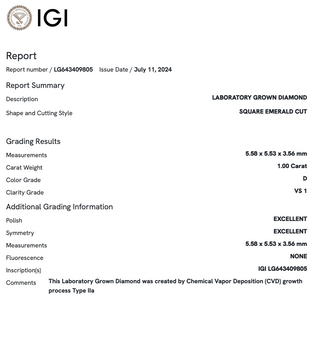
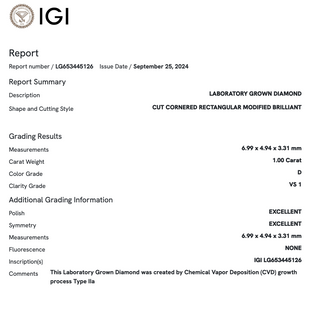
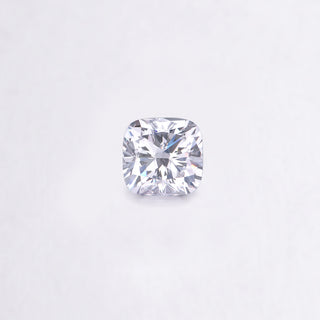
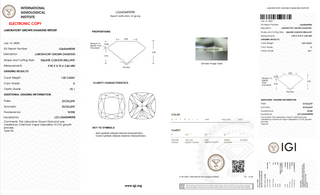
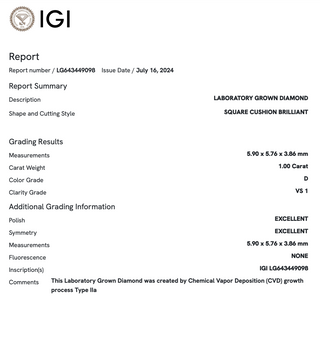
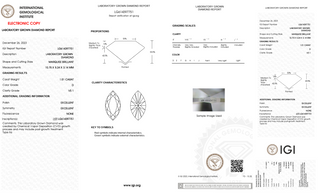
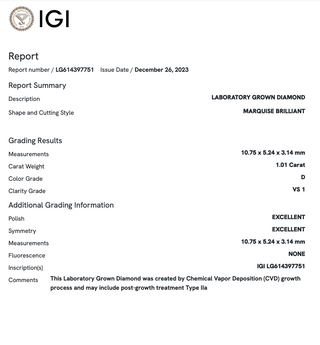
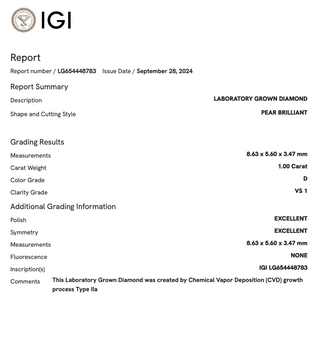
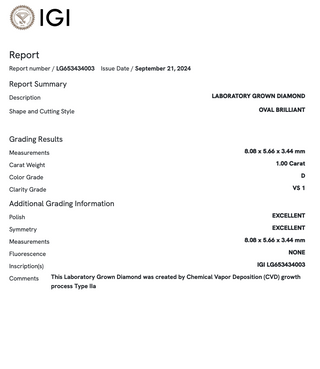
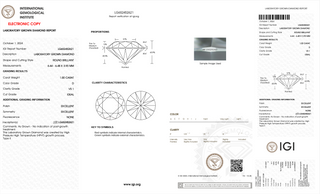
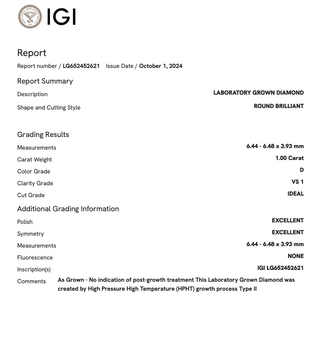
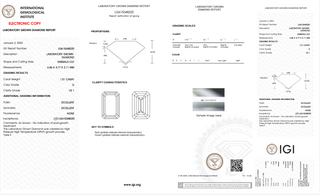
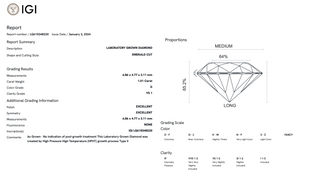
Every lab-grown diamond here carries IGI certification, across a range of carat weights and across asscher, radiant, cushion, marquise, pear, oval, round and emerald cuts. They are chemically and structurally identical to mined diamonds: same carbon lattice, same 10 on Mohs, same optical behaviour. The difference is a growth chamber and a matter of weeks rather than geological time.
Carat is weight rather than width, which is why every stone lists a face-up millimeter dimension alongside it — doubling the weight adds only about a quarter to the visible diameter. The full sub-collection sits at loose lab-grown diamonds, and if you would rather buy something already set, see lab-grown diamond engagement rings.
The Odd Ones: Colored Stones and Fantasy Cuts
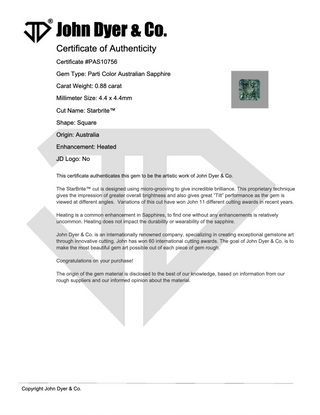
Alongside the two main families we occasionally carry single colored stones — including a parti-color Australian sapphire in a Starbrite cut by gem artist John Dyer, where the stone shows more than one color zone within a single crystal. These are genuinely one-off; when a stone like that sells, it does not come back.
Fantasy and concave cuts belong in the same category. Rather than following a standard facet plan, they use curved or sculpted surfaces to move light in ways a conventional brilliant cannot. They suit people who want the stone itself to be the unusual element rather than the setting. Related colored options already set can be found under sapphire engagement rings and gemstone rings.
These stones also move differently from the rest of the collection, and it is worth saying plainly: a cut moissanite in a standard shape can be replaced if something happens to it, and a one-carat certified lab diamond can be matched almost exactly. A single parti-color sapphire cannot be replaced by anything, because the color zoning came from one crystal that grew once. If that appeals, buy it when you see it rather than planning around it.
What to Check Before You Buy a Loose Stone
Four things, in order. Hardness first: anything you intend to wear daily wants 8 or above, which covers moissanite at 9.25, sapphire at 9 and diamond at 10. Second, certification — for a lab-grown diamond, an IGI or GIA report is the only meaningful proof of the grades claimed. Third, the cut's proportions, because a poorly proportioned stone of good material will always underperform a well-cut stone of lesser material.
Fourth, and most often forgotten: know roughly what setting you intend before you buy. A stone with a sharp point — marquise, pear, heart, kite — needs a prong or V-tip protecting that tip, and a step-cut emerald wants a setting that does not crowd its corners. Deciding the stone and the setting in isolation is how people end up re-cutting.
Measurements matter more than carat weight when you get to that stage. Two one-carat stones of the same shape can differ meaningfully in face-up diameter depending on how deep the cutter left them, and it is the face-up dimension — not the weight — that determines whether a stone fits a given head or how large it reads on a hand. Ask for millimeter dimensions rather than relying on carat alone.
Loose Gemstones FAQs
Can I have a loose stone set into one of your rings?
Setting a customer-supplied or separately purchased stone is handled as a custom piece rather than a standard order, and timelines differ from stock items — see how long custom jewelry takes. Contact us with the stone's shape and dimensions before ordering so we can confirm what is workable.
Is moissanite the same as a lab-grown diamond?
No. Moissanite is silicon carbide; a lab-grown diamond is carbon and is identical to a mined diamond. They are different materials with different hardness, different refractive index and different price positions. Full explanation in is moissanite a lab-grown diamond.
How hard is moissanite, and will it scratch?
Moissanite is 9.25 on the Mohs scale, second only to diamond at 10 among stones in common use. It resists scratching from everyday material easily — household dust is quartz at 7. It is a genuine daily-wear stone, which is not true of softer options like opal or turquoise.
Why does moissanite sparkle more than diamond?
Refractive index. Moissanite is about 2.65 against diamond's 2.42, so light bends harder inside it and exits more separated into spectral color. It is also doubly refractive rather than singly refractive. The result is more visible fire, which some people want and some specifically avoid.
Are your lab-grown diamonds certified?
Yes — every loose lab-grown diamond here carries IGI certification, across all carat weights offered. Independent certification is the only meaningful verification of color and clarity grades. See the sub-collection at loose lab-grown diamonds.
Are lab-grown diamonds real diamonds?
Yes. They share the identical carbon crystal lattice, hardness of 10 on Mohs, and optical properties of mined stones — the difference is origin, not material. Our guides to how lab-grown diamonds are made and lab-grown vs natural diamond cover CVD and HPHT growth in detail.
Which cut makes a stone look largest?
Elongated cuts — marquise, oval and pear — cover more finger surface than a round stone of equal carat weight, because weight sits in the length rather than the depth. Round and cushion cuts look smaller for the same weight but return light most evenly. See the marquise guide.
What is the difference between a brilliant cut and a step cut?
Brilliant cuts use triangular and kite-shaped facets to scatter light into many small flashes, and they conceal inclusions well. Step cuts — emerald and asscher — use long parallel facets that produce fewer, broader flashes and show clarity honestly. Step cuts demand a cleaner stone; brilliants are more forgiving.
Do lab-grown diamonds hold their value?
This is worth understanding before buying rather than after. We wrote a direct answer at do lab-grown diamonds hold value — the short version is that resale behaves differently from mined stones, and buying for wear rather than investment is the sound approach with any modern stone. The same logic applies across diamond jewelry generally.
How does moissanite compare to cubic zirconia?
They are not close. Cubic zirconia is far softer, clouds with wear and has a much lower refractive index. Moissanite at 9.25 Mohs is a lifetime stone suitable for everyday couples' rings; CZ is not. Detail at moissanite vs cubic zirconia.
Can I buy a colored loose stone rather than a colorless one?
When available, yes — colored single stones appear here individually and are genuinely one-off. For colored stones already set, see sapphire engagement rings, aquamarine rings or the wider gemstone rings range.
Should I choose the stone or the setting first?
The stone, if you care most about the stone. But decide the rough setting style before you commit, because pointed cuts need protected tips and step cuts need uncrowded corners. Browse engagement rings for women and moissanite rings to see how each shape behaves in metal.
From the Blog

Diamants créés en laboratoire : Le guide complet
Un guide complet sur les diamants de laboratoire : sont-ils de vrais diamants, comment sont-ils fabriqués, leur coût, leur certification, leurs avantages et inconvénients, et si l'achat en vaut la peine.

Comment sont fabriqués les diamants de laboratoire ? Explications sur les méthodes HPHT et CVD
Comment les diamants de laboratoire sont-ils fabriqués ? Un guide clair sur les méthodes HPHT et CVD, comment un germe de diamant se transforme en cristal brut, combien de temps...

Certification IGI ou GIA : à qui faire confiance en 2026 ?
Certification des diamants IGI vs GIA expliquée : ce que sont chaque laboratoire, leurs différences, lequel grade les diamants de synthèse, si le GIA est plus strict, et comment lire...

Diamants de laboratoire ou diamants naturels : la comparaison honnête
Diamants de laboratoire vs diamants naturels : une comparaison honnête de ce qui est identique et de ce qui est différent — prix, valeur de revente, rareté, éthique — pour vous...