


Moissanite vs Diamond: The Complete Guide to Choosing Your Perfect Stone
Moissanite vs diamond is more than a comparison of sparkle or price. It’s a question of values, identity, and how you want your love to be seen.
One stone is shaped by centuries of tradition and rarity. The other, born from starlight and science, challenges what luxury can look like today. At Aquamarise®, we believe choosing an engagement stone should feel thoughtful and personal.
In this guide, you’ll explore the differences between moissanite and diamond, covering appearance and durability, cost, ethics, and long-term wear. More importantly, you’ll learn how to choose the stone that reflects your story, not someone else’s expectations.
The Origin Story: Where Moissanite and Diamond Come From
Every moissanite vs diamond comparison eventually leads here. Not to price or sparkle. But to the origin. Because where a gemstone comes from shapes how we understand its value scientifically, historically, and emotionally. At Aquamarise®, this is where meaning begins.

Diamond: Forged by Time and Pressure
Diamonds are shaped in darkness. Formed deep beneath the earth’s surface, they emerge after billions of years under extreme heat and pressure, conditions so intense they feel almost mythic.
Long before they were symbols of love, diamonds were geological miracles, carried upward by volcanic force and discovered by chance. This earth-bound origin has long defined their allure.
Rarity. Permanence. A sense of endurance carved by time itself.
Today, diamonds also exist in lab-grown form, created through advanced technology that mirrors the conditions of the Earth’s mantle. Chemically and structurally identical to mined diamonds, these stones share the same internal makeup, but their story shifts.
The mystery of time gives way to precision. The romance of geology becomes a feat of human mastery.
Moissanite: Discovered in the Stars
Moissanite’s story is far less expected.
In the late nineteenth century, Nobel Prize-winning chemist Dr. Henri Moissan discovered microscopic crystals of silicon carbide inside a meteorite crater in Arizona. This material did not originate from the earth. It arrived from space.
A fragment of the cosmos, resting quietly in stone.
Natural moissanite exists only in microscopic traces and is far too rare to be used in jewelry. For decades, Dr. Moissan attempted to recreate it. He never succeeded.
It wasn’t until the late 1990s that scientists in North Carolina developed a method to grow pure silicon carbide in controlled laboratory environments. This breakthrough made moissanite jewelry possible for the first time.

The Chemistry Reality
Modern moissanite is lab-created, but it is not an imitation. It is real silicon carbide, the same material discovered in that meteorite over a century ago.
The process takes months, not days, to produce a single gemstone, resulting in exceptional clarity, durability, and brilliance.
This is why the moissanite vs. diamond debate is not about real versus fake.
It’s about earth versus cosmos, tradition versus innovation, and which origin story resonates with you. In the end, both stones are extraordinary. They simply come from very different worlds.
Moissanite vs Diamond: What Does the Sparkle Really Look Like?
When people search for moissanite vs. diamond, they’re usually asking one thing: what will I actually see when it’s on my hand? Sparkle is not just light. It’s movement, mood, and presence. And while both stones are brilliant, they speak very different visual languages. Let’s look closely.

Another way to tell the difference is by examining the stone’s clarity and visual pattern. When viewed under magnification, moissanite may show a doubling effect in its facets due to its crystal structure, whereas diamonds do not. This doubling is not always easy to spot with the naked eye, but trained jewelers can identify it using a loupe or microscope.
Hardness and durability can also offer clues, though both gemstones are suitable for everyday wear. Diamonds rank a 10 on the Mohs scale of hardness, making them the hardest natural substance, while moissanite ranks slightly lower at 9.25. While this difference is minimal in daily use, professional testing tools such as diamond testers can accurately distinguish between the two by measuring thermal and electrical conductivity. For a definitive answer, having the stone evaluated by a certified jeweler is always the most reliable option.
Brilliance: The White Light
Brilliance is the crisp white light reflected back to the eye. Diamonds are famous for it. Their sparkle is sharp, controlled, and elegant; light flashes on and off with restraint, like candlelight in a dark room.
Moissanite, however, reflects even more white light than diamond. It appears brighter at first glance, especially in larger stones. This heightened brilliance gives moissanite a luminous, almost glowing quality.
In side-by-side comparisons, moissanite looks whiter and more radiant, while diamond appears more subtle and refined. This difference addresses much of the conversation about the appearance of moissanite vs. diamond.
Dispersion: The Rainbow Fire
Dispersion is where moissanite truly reveals its personality. This is the rainbow fire, the flashes of color that dance as the stone moves.
Diamonds produce restrained, elegant fire. Moissanite produces more…significantly more fire. Its higher dispersion means stronger rainbow flashes, especially under sunlight or bright indoor lighting. Some describe this as magical. Others prefer the quieter fire of a diamond ring.
Neither is better. One is theatrical. The other is classic. This is the heart of the moissanite fire vs diamond debate.

Color: The Hue
Diamonds are graded on a strict color scale, from icy white to warmer tones. Higher-grade diamonds appear neutral and clean, while lower grades carry subtle warmth.
Moissanite is typically near-colorless, though certain cuts and sizes may show a faint warm tone in certain lighting. Modern moissanite is engineered for clarity and brightness, appearing whiter than many natural diamonds in everyday wear.
In practical terms, most people notice brightness before hue.
Clarity: The Inclusions
Diamonds are natural, which means inclusions are common. Even high-grade stones contain tiny internal characteristics that are part of their identity.
Moissanite is lab-created and typically appears eye-clean, with fewer visible inclusions. This gives it a smooth, uninterrupted sparkle that some find strikingly modern.
If clarity matters visually, moissanite often wins at the same size and price point.
Can You Tell Them Apart?
In casual settings? Rarely.
Under a jeweler’s loupe or specialized lighting? Yes, moissanite’s sparkle is more intense and colorful.
Most people don’t ask whether you can tell moissanite from a diamond. They ask which one feels right to them. In the end, the sparkle debate isn’t about superiority. It’s about style. And the right choice is the one that reflects you.
Moissanite vs Diamond: Side-by-Side Comparison
|
Feature |
Moissanite |
Diamond |
|
Brilliance |
Extremely bright |
Bright, refined |
|
Fire |
Bold, rainbow-like |
Subtle |
|
Color |
Typically near-colorless |
Graded natural range |
|
Clarity |
Usually eye-clean |
Natural inclusions |
|
Overall Look |
Radiant, expressive |
Classic elegance |

Moissanite vs Diamond Durability: Will Your Stone Truly Last a Lifetime?
Beauty draws the eye, but endurance is what turns a ring into an heirloom. When the conversation moves beyond the sparkle of moissanite vs. diamond, it settles on a curious question.
Will this stone live with you? Through ordinary days, through years that leave their mark, and through time itself?
Longevity is not romance. It is structure. And understanding that structure reveals why both stones have earned their place at the center of modern love stories.
Hardness on the Mohs Scale
Hardness speaks to resistance. It measures how a gemstone stands up to the friction of life, the brushing against countertops, keys, other jewelry, and the small contacts that happen without thought.
Diamond rests at the pinnacle of the Mohs scale with a rating of ten, the hardest natural material known. This reputation has shaped centuries of symbolism around permanence and strength.
Moissanite follows closely at 9.25. A difference that appears meaningful on paper, yet disappears in real life.
Both stones resist everyday scratching with ease. Both are suited for continuous wear. From a hardness perspective, the question “will moissanite last” has a clear answer. Yes. Without hesitation.
This is why moissanite durability is discussed alongside diamond, not alongside softer gemstones that require compromise.

Toughness: Resistance to Breaking
Hardness alone does not tell the full story. Toughness describes how a gemstone responds to impact: it absorbs sudden force rather than resisting abrasion.
Diamonds are exceptionally hard, but their crystalline structure means they can chip when struck at specific angles. This is rare, yet possible. Moissanite behaves differently. Its internal structure allows it to absorb impact more flexibly, making it slightly more forgiving in daily wear.
In reality, both stones perform beautifully in engagement rings. With thoughtful design and proper setting, neither is fragile. The distinction in diamond vs moissanite durability is subtle, a matter of behavior rather than strength.
Wear Over Time
Over decades, true durability reveals itself not in dramatic moments, but in the consistency with which a stone holds its surface, how it maintains its polish, how it responds to years of contact with the world.
Both diamond and moissanite maintain their brilliance remarkably well. They resist abrasion. They keep their edges crisp. They retain their presence without requiring extraordinary care.
This is why both stones are trusted for rings meant to be worn every day.

The Clouding Myth
Few misconceptions persist as stubbornly as the idea that moissanite becomes cloudy over time. It does not.
Moissanite does not haze, fog, or lose clarity through wear. Its optical properties remain stable. Any dullness that appears is surface residue, the same oils and buildup that affect all fine jewelry. Proper cleaning restores its original brilliance instantly.
When cared for thoughtfully, moissanite retains its clarity just as a diamond does.
What Durability Really Means
In the end, durability is not about surviving a test. It is about living beautifully. Both diamond and moissanite are stones chosen for permanence. Both are capable of lasting a lifetime and beyond.
The choice between them is not about endurance. It is about which story you want to wear every day. At Aquamarise®, we believe longevity should never be a compromise. Only a constant.

Moissanite vs Diamond Price: What You Are Truly Paying For
In fine jewelry, price is never just cost. It is history, scarcity, labor, and perception layered together. When comparing moissanite vs diamond price, the difference is not about value lost. It is about a value defined differently.
Understanding what you are paying for allows the decision to feel informed. Consider this an unveiling of the numbers beneath the romance.
Diamond Pricing
Diamond pricing is shaped by rarity, grading, and decades of market positioning. Cost increases exponentially with carat weight, clarity, and color. A one-carat diamond of high quality often sits in the upper thousands, and prices climb quickly from there.
Even lab-grown diamonds, while more accessible than mined stones, follow similar pricing structures. Their value reflects advanced production methods, grading standards, and the enduring prestige attached to diamond itself.
This is why diamond pricing remains one of the most significant investments in fine jewelry. You are paying not only for the material but also for centuries of cultural symbolism.

Moissanite Pricing
Moissanite tells a different story. Created in laboratories from silicon carbide, it removes geological scarcity from the equation. This allows its pricing to reflect craftsmanship rather than rarity.
A moissanite engagement ring of comparable size and visual impact typically costs a fraction of a diamond's price. This is the heart of the moissanite diamond cost comparison. It is not that moissanite is lesser. It is that its origin allows freedom.
Freedom in size. Freedom in design. Freedom to choose artistry over constraints. For many, this answers the question of how much cheaper moissanite is than diamond.
Moissanite vs Diamond: Savings
The savings offered by moissanite are not small. They are transformative. The difference often reaches several thousand dollars, which can be redirected into custom design, meaningful details, or simply peace of mind.
This is where the moissanite vs diamond price becomes a personal equation. What matters most is not what you spend, but what you receive in return.

Ethical and Environmental Considerations
Luxury is no longer defined only by how something looks. It is defined by what it leaves behind. When considering ethical moissanite vs diamond, the conversation moves beyond sparkle and into responsibility. Into impact. Into legacy.
A ring may be small, but its origin is not.
Diamond Mining Impact
Traditional diamond mining reshapes the earth in visible and lasting ways. Forests are cleared. Habitats are disrupted. Rivers carry sediment, chemicals, and heavy metals downstream. Heavy machinery releases dust and greenhouse gases into the air, altering ecosystems and affecting nearby communities.
According to industry research, mined diamonds generate approximately 2.63 tonnes of mineral waste per carat and an estimated 57 kilograms of greenhouse gas emissions. These numbers reflect not just extraction, but transportation, processing, and long-term land use.
Beyond environmental cost, mining has historically carried human consequences. Community displacement and the legacy of conflict diamonds have left a permanent mark on the industry.
While regulation and ethical sourcing have improved conditions in many regions, the footprint of mining remains substantial.
Lab-Grown Diamond Impact
Lab-grown diamonds reduce the need for excavation and eliminate many of mining’s social concerns. They are created in controlled environments, offering greater transparency and traceability.
Their environmental impact, however, depends largely on energy sources. Some industry analyses suggest lab-grown diamonds can produce up to sixty percent less carbon footprint than mined diamonds across their lifecycle.
When produced using clean or renewable energy, mineral waste drops dramatically to approximately 0.0006 tonnes per carat, with greenhouse gas emissions reduced to near-negligible levels. Progress, in this case, is measurable.

Moissanite Ethical Advantage
Moissanite begins with a different intention altogether. It is entirely lab-created, requiring no mining, no land displacement, and no environmental excavation. Its production is deliberate, precise, and controlled.
Because moissanite does not rely on geological scarcity, its impact is significantly lighter. There is no mineral waste from extraction. No altered ecosystems. No communities are displaced to bring beauty to the surface.
This is why moissanite's environmental impact resonates so deeply with modern values. It represents a form of luxury that does not borrow from the future to decorate the present.
The Values Question
Choosing between moissanite and diamond rings is not a moral test. It is a personal one.
Some are drawn to tradition, shaped by time and earth. Others are drawn to innovation, shaped by intention and care. Both paths can be meaningful.
At Aquamarise®, our commitment is woven into every design, nature-inspired jewelry crafted with responsibly sourced gemstones and enduring luxury craftsmanship, chosen with care, transparency, and respect for both people and planet, so each piece carries meaning that lasts a lifetime.
Diamond vs Moissanite: Resale Value and Investment
Buyers ask a practical question beneath an emotional purchase: Will this ring hold value over time?
In the conversation around moissanite vs diamond investment, resale is not about romance but realism, and true luxury is honest about both.

Diamond Resale Value
Diamonds have long been associated with resale strength, but the reality is more nuanced than tradition suggests. Most mined diamonds resell for less than their original retail price, often significantly so. Markups, branding, and market fluctuations all play a role.
Lab-grown diamonds introduce a different dynamic. While they share the same chemical structure as mined diamonds, their resale value is still evolving. What is clear is demand.
According to Fortune Business Insights, the global lab-grown diamond market is projected to grow from $29.46 billion in 2025 to $33.54 billion in 2026, indicating strong and accelerating consumer acceptance.
Resale, however, remains market-driven. Lab-grown diamonds typically resell for less than mined stones, but their long-term value is tied to adoption, not scarcity.
Moissanite Resale Value
Moissanite follows a different philosophy. It is not positioned as a speculative asset. It is chosen for beauty, durability, ethics, and design freedom.
From a resale perspective, moissanite rings generally retain approximately 20 to 40 percent of their original purchase price. Moissanite is not purchased as an investment stone in the first place. It is purchased as an expression of personal values and intentional luxury.
For many, that trade-off feels liberating.
Which to Choose Based on Resale?
If resale potential is a primary concern, a diamond may feel more aligned. If meaning, ethics, and visual brilliance matter more than future liquidation, moissanite offers extraordinary value. At Aquamarise®, we believe the best investment is the ring you never want to sell.
Personal Values Framework: Choosing What Feels Right
Choosing between moissanite vs diamond for engagement rings is rarely about specifications alone. By the time someone reaches this decision, they already know the facts. So what remains is alignment with your taste, your values, and your life.
At Aquamarise®, we encourage you to step away from comparison charts for a moment and listen inward. The right stone is the one that fits not only your hand, but your worldview.

Step One: Aesthetic Instinct
Some are drawn to restraint. Others to radiance.
Diamonds offer a familiar elegance that has defined engagement rings for generations. Moissanite, by contrast, catches the light with unapologetic brilliance. Its sparkle is expressive, modern, and unmistakably its own. Neither is better. One simply speaks louder.
Step Two: Values and Meaning
For many, beauty is inseparable from ethics. Moissanite appeals to those who prioritize sustainability, innovation, and transparency.
Diamonds, whether mined or lab-grown, often resonate with those who value tradition and cultural symbolism. This is not about right or wrong. It is about resonance.
Step Three: Practical Reality
Budget matters, not as a limitation, but as a design tool. Moissanite allows for larger stones, intricate settings, and custom work without compromise.
Diamonds command higher prices, especially as size increases.
Lifestyle matters too. Both stones are durable enough for everyday wear. Your habits simply guide the setting.

Choose Moissanite If
- You love maximum sparkle and visible fire
- Ethical sourcing and sustainability are central to your decision
- You want creative freedom in size or design
- You embrace distinction over tradition
Choose Diamond If
- You prefer subtle brilliance and classic aesthetics
- Cultural symbolism and legacy matter deeply to you
- Resale potential feels important
In the end, the question is not which is better. It is what feels more personal to you.

What the Experts Say: Industry Perspective
When the question is moissanite vs. diamond, expertise is not about crowning a winner. It is to illuminate the truth beneath the sparkle.
And increasingly, that truth is nuanced, modern, and refreshingly honest. Today’s gemologists and market analysts are not divided by tradition. Data unite them.
Gemologist Perspective
From a gemological standpoint, moissanite is evaluated not as a stand-in, but as a stone with its own identity.
According to gemological standards, moissanite’s refractive index exceeds that of diamonds, giving it a fire so luminous that seasoned jewelers often describe its sparkle as electric. This is not a matter of opinion. It is a measurable optical reality.
With a hardness of 9.25 on the Mohs scale, moissanite sits just below diamond, making it exceptionally suited for everyday wear. In professional laboratories, moissanite is assessed on performance, durability, and brilliance. Not on whether it imitates tradition, but on how confidently it stands apart from it.
Market Trends
Across the fine jewelry industry, preference is shifting from tradition alone toward intention.
Contemporary research shows that a growing number of engagement ring buyers prioritize ethical sourcing, environmental responsibility, and transparency alongside beauty. This shift has elevated moissanite from alternative to aspirational.
Moissanite’s rise is not driven by compromise. It is driven by confidence.
Buyers are no longer asking how closely a stone imitates a diamond. They are choosing stones that align with their values, aesthetics, and worldview. In this context, moissanite is not replacing diamonds. It is standing beside them.
What We Recommend at Aquamarise®
At Aquamarise®, we do not believe experts exist to tell you what to choose. Their role is not to persuade, but to guide.
Diamonds remain powerful symbols of tradition and permanence. Moissanite represents innovation, ethics, and brilliance without apology.
The right choice is the one that resonates when you look down at your hand and feel understood. That is the stone worth choosing.

Myths and Misconceptions
The conversation around moissanite vs diamond is often clouded by assumptions passed down through decades of marketing, tradition, and half-truths.
When a gemstone challenges expectations, myths tend to follow. Let’s set them gently aside.
Myth 1: “Moissanite is a fake diamond.”
Moissanite is not an imitation. It is a distinct gemstone with its own chemical structure, optical behavior, and history. It does not pretend to be a diamond, nor does it need to.
Calling moissanite “fake” misunderstands what it is: a real stone chosen intentionally for its brilliance, ethics, and character.
Myth 2: “Moissanite gets cloudy over time.”
This belief lingers from early, outdated simulants. Modern moissanite does not cloud, fade, or lose brilliance. Its crystal structure remains stable for a lifetime. With routine care, it retains the same clarity and fire it had on day one.
Myth 3: “Everyone can tell moissanite from diamond.”
In reality, even trained eyes require magnification and testing. To most observers, the difference is not obvious. What is noticeable is the light. Moissanite sparkles differently, more vividly. Some see this as a distinction, not a disguise.
Myth 4: “Moissanite is cheaper because it’s inferior.”
Price reflects origin and production, not quality alone. Moissanite costs less because it is not subject to mining scarcity, not because it lacks beauty or durability. Lower cost does not diminish its worth. It expands access to exceptional design.
Myth 5: “Diamonds are always the better investment.”
Most engagement rings are not financial investments. Diamonds often resell for far less than their purchase price. Value, in this context, is emotional and symbolic, not speculative.
Myth 6: “Diamonds are always more durable.”
Diamonds are harder, but hardness is not the same as toughness. Moissanite performs exceptionally well in daily wear and resists chipping with impressive resilience. Both stones are suited for a lifetime when thoughtfully set.
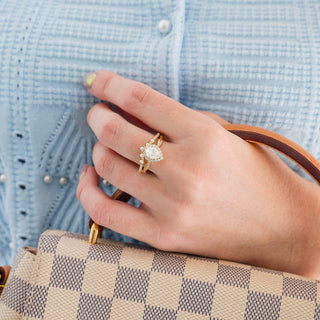
How to Choose a Stone for Engagement Rings: Diamond vs Moissanite
These steps are meant to guide you toward a choice that feels intentional and personal.
Step 1: Define Your Non-Negotiables
Begin with what truly matters to you. Is it sparkle, tradition, ethical sourcing, longevity, or budget? Some people feel strongly about sustainability or design freedom. Others are drawn to heritage and symbolism.
Write down two or three priorities you will not compromise on. This becomes your compass when choosing between diamond and moissanite, keeping the process focused and grounded.
Step 2: View Both Stones in Person
No guide replaces seeing a stone with your own eyes. Diamond and moissanite interact with light in different ways, and that difference is best understood in motion.
Watch how each stone responds to daylight, candlelight, and evening glow. Often, this moment answers the question of which gemstone to choose more clearly than any comparison chart.
Step 3: Consider Your Partner’s Preference
An engagement ring is intimate, even when it is a surprise. Think about what your partner values. Do they lean toward bold expression or refinement? Are they inspired by innovation, or anchored in tradition? The right stone is the one that feels unmistakably theirs.
Step 4: Consult With Aquamarise®
This is where guidance becomes collaboration. At Aquamarise®, we help translate emotion into design.
Whether you are comparing diamond vs moissanite, refining a setting, or creating something custom, our role is to listen first and advise second.
We offer both stones because the right choice is yours.
Step 5: Decide With Confidence
When your priorities are clear, the decision often feels effortless. Whether you choose diamond or moissanite, you are selecting a stone meant to be worn daily, loved deeply, and carried forward through time. The right choice is not the one that convinces others. It is the one that feels right the moment you say yes.
FAQs
Wrap Up
At Aquamarise®, every ring begins with intention. Choosing between moissanite and diamond is never about compromise. It is about alignment.
Our ethically crafted engagement rings celebrate both stones with equal reverence, offering luminous moissanite and timeless diamonds, each set with intention and care.
Designed for those who value beauty with meaning, every piece reflects individuality, integrity, and refined craftsmanship. Explore our engagement rings collection and choose the stone that resonates with your story, your values, and the way you love.