


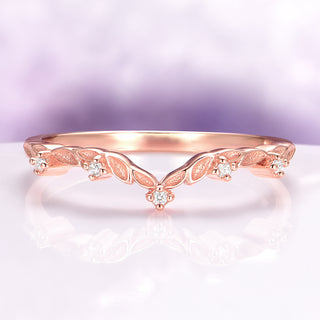
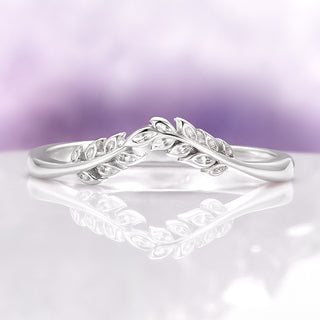


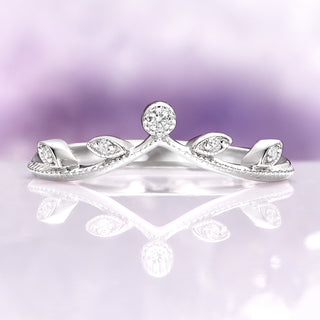

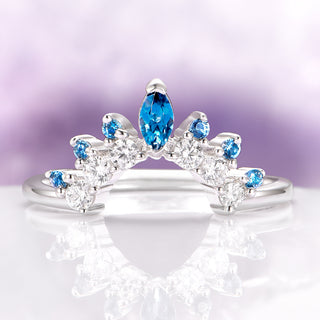


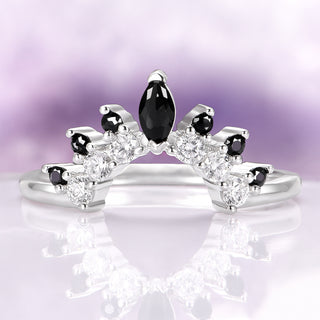
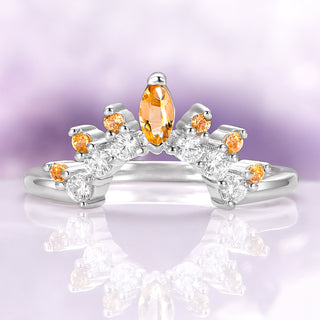
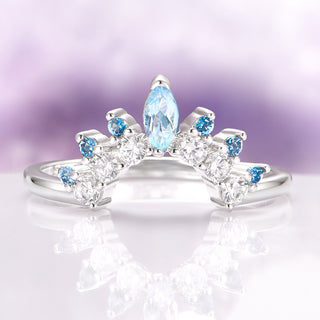


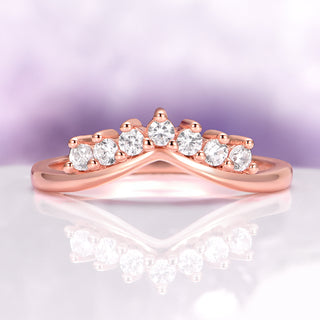


A curved wedding band solves the oldest problem in ring stacking: a straight band and a prominent engagement ring fight for the same space, leaving a sliver of daylight between them or grinding shoulder against stone. The contour band answers by bending — an arc, a chevron, a crown — shaped to trace the engagement ring’s profile and nest against it flush. In this collection the curves come set with marquise and baguette accents, London blue topaz, alexandrite, moss agate, and simulated diamond, hand-finished in 925 sterling silver with a rhodium finish, 14K gold vermeil, and solid 14K gold.
Bands That Nest, Not Fight
The fit is the whole point. A gentle arc cradles a low round or oval solitaire; a deeper U hugs a tall center stone; a chevron’s V frames a pointed pear or marquise; a crown’s peak sits up into the gap a framed center leaves. Get the curve right and the two rings read as one designed object — our guide to setting types shows which engagement silhouettes leave which gaps.
Contour, Chevron & Crown: Three Curves, Three Jobs
The collection sorts into three working shapes. The contour — a smooth arc — is the diplomat: it follows the underside of most low-set engagement rings and disappears into the stack, the shape to choose when you want the pair seamless. The chevron bends to a point instead, a V that frames pointed stones and adds architecture even worn alone; a curved wishbone wedding ring is its softer, open-ended cousin.
The crown curves upward in a peak or tiara line, made for framed and high-set centers — and bold enough that many wearers stack two, points opposed, as a diamond-shaped frame around the engagement ring. Marquise and baguette accents follow each curve’s line; a curved filigree wedding band adds vintage lace to the arc. Every listing photographs its curve against a straight edge so you can judge the depth before it reaches your hand.
Curved Bands in Sterling Silver, Vermeil & Gold
Shoppers comparing a silver curved wedding band against gold options can usually match the same silhouette across tiers: 14K gold vermeil carries the FTC’s full 2.5 microns of gold over sterling, and solid 14K gold versions are stamped 585 in yellow, rose, and white.
Stones ride every curve: icy London blue topaz along an arc, color-shifting alexandrite in a chevron, botanical moss agate in a mountain-line band, marquise and baguette clusters for the vintage crowd, and bright simulated diamond — including a curved cubic zirconia wedding band option — for maximum sparkle at entry prices. Each listing names its stones, metal tier, and curve depth plainly.
Matching the Curve to Your Engagement Ring
Choosing is a profile-matching exercise. Low bezel and solitaire settings want a shallow arc — just enough bend to clear the basket. A halo or other framed center leaves a wider, rounder gap that a deeper contour or crown fills cleanly. Pointed pear and marquise stones call for a chevron whose V echoes their angle, and a three-stone ring’s gentle triple arc nests best over a soft curve.
Two practical notes: wear the pair for a day before judging — curves settle against a hand differently than on a tray — and match metals by tier so the rings age in step, sterling with sterling and gold with gold. Worn alone, a curve is simply a beautiful band; stacked with anniversary rings later, arcs and chevrons keep making room the way straight bands never can, which is why the curve is the stack-builder’s favorite shape.
Curved vs Straight vs Eternity: Building the Stack
The wedding-band family splits by geometry. Straight bands are the timeless default and stack endlessly — the full wardrobe lives in women’s wedding bands — but they assume the engagement ring leaves them room. Contours are the tailored answer when it doesn’t. Eternity bands circle stones all the way around and pair with either. Many brides land on a hybrid stack: contour against the engagement ring, straight band or eternity ring beyond it, each new ring finding its own line.
Curved Bands Worn Alone — and in Couples’ Sets
Off the stack, a chevron reads as modern geometry and an arc as a subtle wave — plenty of wearers buy the curve as a standalone right-hand ring. For weddings proper, many designs here pair with a partner’s band through couples rings, matched by metal and finish, and complimentary engraving puts the date or a private line inside both.
Every Aquamarise band is hand-finished and ships worldwide with insured delivery and a 14-day return window on non-customized pieces. We hold a 4.9-star average across 38,000+ reviews collected on our store and on Etsy, where we have sold since 2016.
From the Blog

Engagement Ring Styles & Setting Types: The Complete Guide
The complete expert guide to engagement ring styles and setting types: solitaire, halo, three-stone and more, plus prong, bezel, pavé and channel settings, and how to choose.

Wedding Ring Sets for Him and Her - The Complete Matching Guide
Wedding ring sets for him and her: how to choose matching or complementary designs, coordinate metals, judge quality, get the fit and sizing right, and budget.

Ring Size Chart: US, UK & EU Conversions and How to Measure
A complete ring size chart with US, UK, Australian and European conversions plus exact diameter and circumference in millimeters and inches — and the sizing rules most charts leave out:...

How to Care for Your Engagement Ring: When to Take It Off & Maintenance Tips
Your love is bulletproof — your ring is not. A complete guide to when to remove it, how to clean every metal safely, gemstone-specific care for moss agate, opal, moissanite...
Curved Wedding Bands FAQs
“My soon to be wife and I absolutely love the Aquamarise rings.”
“Beautiful. Fits perfectly with a kite set that I bought to wear as my wedding set.”
“I bought this for my partner as a wedding band. They love it, it's beautiful, well made, and fits perfectly.”
“Very good quality, even more impressive than in the photos.”