


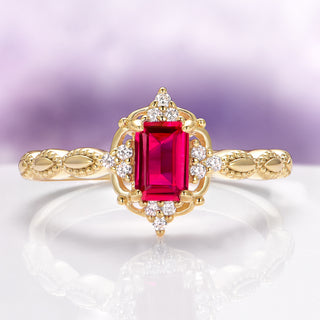
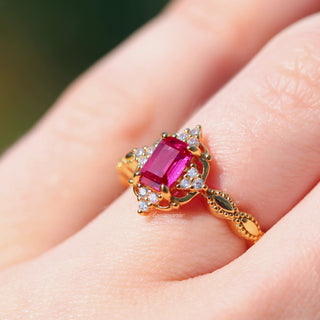


Ruby jewelry begins with a mineral fact that explains everything else: ruby is corundum colored by chromium — the same mineral that becomes sapphire in every other shade — and at Mohs 9 hardness it is second only to diamond among the classic gemstones. That pairing of saturated red and near-diamond durability is why the stone has outranked every rival for most of recorded history. This collection gathers 75 handcrafted ruby pieces — necklaces, earrings, pendants, and rings — in 925 sterling silver, 14K gold vermeil, black ruthenium, and solid 14K gold.
Why Ruby Jewelry Is Called the King of Gemstones
Ancient Sanskrit texts named ruby ratnaraj — king of precious stones — and the title has never seriously been challenged. Roman tradition treated ruby as a stone of protection; Burmese tradition placed it above every other gem as the stone of life-force; medieval Europe made it the gem of devoted love. What kept the crown in place is the color itself: chromium gives ruby a red no garnet or spinel matches for saturation, along with a natural fluorescence that makes fine stones appear lit from within. Genuine ruby jewelry has carried that authority for over two thousand years, and it still reads unmistakably at a single glance across a room.

Lab-Grown and Natural Ruby Jewelry — Two Honest Tiers
Lab-grown ruby is the standard across this collection, and it is genuine corundum — chemically identical to mined ruby, with the same chromium-driven red, the same Mohs 9 hardness, and the same optical behavior under light. A gemological report identifies both as ruby; it simply notes the growth origin. The price difference reflects production, not visible quality, which is why lab-grown ruby anchors every sterling silver, gold vermeil, and black ruthenium piece here.
Natural ruby jewelry occupies the second tier: mined corundum with documented geological origin, offered in select solid 14K gold and platinum pieces where the material investment matches the stone. Every listing states its tier plainly — no piece leaves the question open. And if you want a natural stone in a design shown with lab-grown ruby, the custom design service can build it to commission, including specific origin and color-saturation requests.
Ruby Necklaces, Earrings & Rings — One Stone, Every Form
Breadth is this collection's point. The ruby heart necklace is its most-gifted piece — a saturated red heart on a fine chain, made as a rose gold ruby necklace in 14K vermeil and, in the Ethereal Hold pendant, in black ruthenium, where deep red meets a dark, moody finish. Ruby earrings run from minimalist solitaire studs to drop silhouettes, and the ring side of the collection spans vintage ruby rings for women, Art Deco–leaning designs, and men's bands with crushed-ruby inlay.
For pieces built around commitment rather than gifting, the matched side of the family lives in ruby wedding bands — eternity, half-eternity, and accent configurations — and ruby couples rings, his-and-hers sets designed to coordinate from the first fitting.

Pigeon-Blood Color — the Glow Fine Ruby Jewelry Is Judged By
Ruby color is graded on hue, tone, and saturation, and the top natural grade is pigeon-blood red: a pure, vivid red with a faint blue undertone, mid-toned and intensely saturated, reading as lit from within. Historically the term belonged to Burmese stones; today it describes that saturation from any origin, and it commands the highest prices in the natural market.
Tone matters as much as hue — too dark and a ruby drifts toward garnet territory, too light and the drama drains out. Lab-grown ruby is grown to the saturated, mid-toned standard deliberately, which is why the red across this collection reads consistently vivid. Under direct light, a well-cut stone at this grade appears to glow rather than merely sparkle — the visual signature that has kept ruby at the top of the colored-stone hierarchy for as long as gems have been graded at all.
Ruby Jewelry Metals Built for Daily Wear
Every metal here is chosen to keep pace with a Mohs 9 stone. 925 sterling silver is a 92.5% solid silver alloy in a bright rhodium finish. 14K gold vermeil carries 2.5 microns of 10K-or-finer gold over that same sterling base — the FTC standard for true vermeil — in yellow and rose tones. Solid 14K gold is 58.5% pure gold, stamped 585, across our solid gold rings; black ruthenium supplies the collection's darkest finish. Ruby itself needs no protective setting at this hardness — prong, bezel, halo, and flush settings are all built for everyday wear.
Shopping for a Ruby Engagement Ring Instead?
Bridal designs have their own dedicated home. If you are here for a proposal — solitaires, halos, three-stone and vintage settings built around a saturated red center stone — that is our ruby engagement rings collection, curated separately so bridal styles and matched sets live in one place. This page remains the broader home for necklaces, earrings, pendants, and non-bridal rings.
Every Aquamarise piece is handcrafted and ships worldwide with insured delivery, complimentary engraving, and a 14-day return window on non-customized pieces, with prices starting from $77. We hold a 4.9-star average across 38,000+ reviews collected on our store and on Etsy, where we have sold since 2016. For a stone-and-setting combination you don't see here, use the custom design service.
From the Blog

Ruby Meaning: Symbolism, History & Healing Lore
Passion, love, courage, and vitality — the King of Gemstones. Ruby's meaning across symbolism, history and mythology, metaphysical lore, its colors and 'pigeon's blood' red, the July birthstone, and how...

Garnet vs Ruby: An Honest Comparison for Engagement Rings
Two red gems, two different minerals, one big price gap. Hardness, color, value, durability, and how to tell garnet from ruby — the honest comparison.

How to Clean Jewelry at Home: Safe Methods for Every Metal & Gemstone
Almost every piece can be cleaned at home — but the method has to match the material. A jeweler's guide to the universal soap-and-water method, metal-by-metal and gem-by-gem instructions, ultrasonic...

The Fascinating History of Gemstones: Meaning, Symbolism & Origins Through Time
How gemstones acquired meaning across 6,000 years — from ancient Egypt, China, and Greece to the Breastplate of Aaron and the 1912 birthstone list.