





Turquoise rings are the most saturated color statement in fine jewelry that does not depend on a diamond, and they are also the most misunderstood — turquoise sits at just 5 to 6 on the Mohs scale, softer than the quartz dust in ordinary household air. Every piece of turquoise jewelry in this collection is built around that single fact. Aquamarise® sets turquoise the way the stone actually wants to be set: inlaid flush into hard structural metal, or bezel-cradled in 925 sterling silver and 14K rose gold vermeil, never left standing proud of the band where a countertop can find it.
This is not Southwestern trade jewelry and it does not pretend to be. It is fantasy- and nature-led design — elk antler, mountain ridgelines, teardrop stacking sets — using turquoise for what turquoise does better than any other gem: it reads blue-green at ten paces, in any light, without a facet doing the work.
Turquoise Rings Behave Differently From Every Other Stone We Set
Turquoise is a hydrated copper aluminum phosphate. Copper produces the sky-blue; iron substituting into the structure pulls it toward green, which is why a green turquoise ring and a blue one can come from the same seam. Because the mineral forms with water locked into its structure, it is porous — it will take up oils, lotions and perfume, and over years those absorbed oils are what actually shift the color, not wear.
That porosity is why almost all commercial turquoise is stabilized: the rough is impregnated with a clear resin that fills the pore network, hardening the stone enough to cut, polish and set without crumbling. Stabilization is standard practice across the industry, not a defect, and it is the reason a turquoise ring can be worn at all rather than living in a display case. What it does not do is raise the Mohs hardness meaningfully — a stabilized stone is still a 5 to 6 stone, which drives every setting decision on this page.
What separates one turquoise from another, then, is not clarity but matrix and evenness. Matrix is the web of host rock left in the stone — spiderwebbing, veining, patches of brown or black — and it is the closest thing turquoise has to a fingerprint. Even, unbroken color commands the highest prices in the trade; heavy, well-defined webbing is prized separately for its character. Neither is a flaw, and no two stones in this collection are interchangeable because of it.

Turquoise Engagement Rings for Brides Who Want Color Instead of Carats
A turquoise engagement ring is a deliberate rejection of the carat-weight conversation. Nothing about turquoise is graded on clarity or brilliance; it is judged on evenness of color and the character of its matrix — the web of host rock running through the stone. Two rings cut from the same block will not match, and that is the appeal.
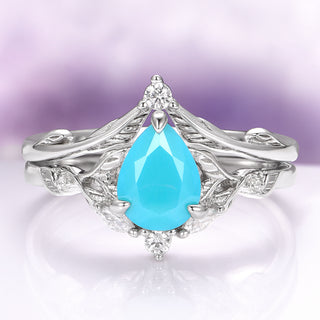
The practical route for daily-wear brides is a set rather than a single ring. Our natural turquoise teardrop stacking set in 14K rose gold vermeil pairs three slim bands so the turquoise sits protected between two harder companions, which is the same logic behind a women's engagement ring with a bezel rather than a raised solitaire. If you want turquoise's color with everyday hardness, a turquoise and sapphire pairing — sapphire is a 9 on Mohs — gives you the blue-green palette with a structural anchor stone.
A turquoise and diamond ring follows the same reasoning from the other direction: the diamond carries the light return and the wear, and the turquoise supplies the color a colorless stone cannot. Set that way, turquoise stops being the vulnerable centerpiece and becomes an accent that can be replaced or reset decades later without touching the ring's structure. For turquoise bridal jewelry more broadly, the reliable formats are accent stones, inlay channels and stacking bands — anything that keeps the stone below or between harder surfaces.
Men's Turquoise Rings Use Inlay to Protect the Stone
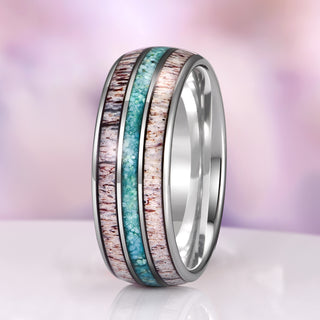
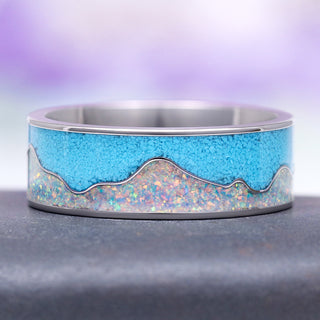
Men's turquoise jewelry has a different engineering problem: hands take more abuse. The answer is channel inlay. Turquoise is crushed, set into a milled channel and ground flush to the metal surface, so the band — not the gem — takes every knock. Our elk antler and turquoise band is inlaid into tungsten carbide; the mountain-ridge design is inlaid into titanium.
Those two metals do the load-bearing. Tungsten carbide is the hardest metal used in men's rings and wedding bands and effectively will not scratch in normal wear; titanium is lighter, more forgiving and comfortable for anyone who dislikes weight on the hand. Either way, the turquoise is below the wear surface. That is the whole trick, and it is why an inlaid men's turquoise ring outlives a set one by a wide margin.
Sterling Silver Turquoise Rings and the Cool-Toned Case for 925
Silver and turquoise jewelry is the pairing most people picture, and there is a real optical reason for it. Sterling silver is 92.5% silver alloyed with 7.5% copper — a solid alloy, not a coating — and its neutral, slightly cool reflectance sits back and lets the blue-green come forward. Warm metals compete; silver defers.
A sterling silver turquoise ring also solves a durability mismatch quietly: silver is soft enough to be reworked by a bench jeweler decades from now without heat stress on a heat-sensitive stone. Browse the wider sterling silver rings range if you want the same tone in other gems, or the men's sterling silver rings edit for heavier profiles.
Rose Gold Turquoise Rings Use Warm Contrast to Change the Blue
Turquoise and gold jewelry works on the opposite principle. Rose gold sits at the far warm end of the metal spectrum, and placing it beside a cool blue-green pushes both colors further apart — the turquoise reads brighter and slightly greener, the gold reads pinker. It is straightforward color theory, and it is the reason a gold turquoise ring photographs so differently from a silver one.
Aquamarise uses 14K rose gold vermeil over a solid 925 base for this effect, which keeps a genuine gold surface at a fraction of solid-gold pricing. If you are deciding between tones, our guide to yellow, white and rose gold walks through how each behaves against colored stones, and the full rose gold rings collection shows the tone across other gems.
Choosing quickly: want maximum daily durability? Choose an inlaid tungsten or titanium band. Want the classic look? Choose sterling silver. Want the strongest color contrast? Choose rose gold vermeil. Want turquoise's palette with engagement-ring hardness? Choose a turquoise-and-sapphire design.
Wearing and Caring for Turquoise Jewelry Without Dulling the Color
Three rules cover almost everything. First, turquoise goes on last and comes off first — after lotion, perfume and hairspray, before washing up or swimming. Second, never use an ultrasonic or steam cleaner; vibration and heat can drive resin out of a stabilized stone and open the pore network again. Third, clean with a barely damp soft cloth and dry immediately, because prolonged water contact is exactly what a hydrated phosphate does not need.
Stored properly — separately, away from harder stones that will abrade it — a turquoise ring holds its color for decades. Turquoise is also one of the three December birthstones alongside tanzanite and blue zircon, which makes it a natural choice for a December birthstone gift as well as a bridal one.
This is a deliberately small, curated edit rather than a broad range — designs, one for each construction described above. We hold a 4.9-star average across 38,000+ reviews collected on our store and on Etsy, where we have sold since 2016.
From the Blog

Blue Gemstones: The Complete Guide to Every Shade & Stone
From royal sapphire to sea-blue aquamarine and bright blue topaz — every blue gemstone worth knowing: what makes them blue, what they mean, how hard they are, and the best...

Titanium vs Tungsten Rings: Pros, Cons & Which to Choose
Titanium vs tungsten rings compared: hardness, weight, comfort, scratch resistance, durability, colors, and price — plus which metal is right for you.

Does Sterling Silver Turn Green?
Pure silver does not turn green. The 7.5% copper in sterling can leave a faint, washable green mark on some skin, dark tarnish is a separate silver-sulfide film, and heavy...

Yellow Gold vs White Gold vs Rose Gold
Yellow gold vs white gold vs rose gold compared: how each color is made, durability, skin-tone matching, care, and which gold color is right for your ring.
Turquoise Jewelry FAQs
“Both rings are so beautiful and unique, we love them and they are exactly what we wanted.”
“I'm beyond happy with my engagement ring! The quality is excellent, the details are perfect, and it arrived exactly as expected.”
“Ordered this set as a small anniversary gift for my girlfriend. We both love them.”
“The rings came out perfect. We love them!”