Your cart

Your cart is empty

London blue topaz couples ring set

Designing Your Own Engagement Ring: A Complete Guide

No two people on this planet have the same thumbprint, the same laugh, or the same weird way of making toast. We are walking, talking mosaics of our own experiences. Yet, for the longest time, when it came to the most symbolic piece of jewelry you’d ever own, we were basically told to “pick a lane.” You went to the local jeweler, looked at the five styles they had in the glass case, and that was that. It was very one-size-fits-all in a world where nobody actually is.

Fortunately, we’ve finally hit a breaking point with that. According to JCK Online, 76% of survey respondents seek to invest in a customized ring. The preference was higher among Gen Z (34%) and Millennials (28%).  USA Today highlights,Custom engagement rings offer a special way to create a keepsake that’s true to your love.” If you’re feeling like the standard solitaire doesn’t represent you, you’re part of a massive movement of people reclaiming their individuality. Let’s get into how you can pull off designing your own ring without losing your mind or your budget.

Aquamarise jeweler making the ring. Person holding a rose gold ring with intricate design, using a small tool.

Why Design Your Own Engagement Ring?

When you think about it, the traditional way of buying a ring is a bit backward. You’re expected to find a forever symbol in a sea of mass-produced settings that were designed to appeal to everyone, which usually means they lack that specific spark that makes them yours.

Designing your own ring changes that. 

It’s a Literal Biography in Metal and Stone

Most store-bought rings are beautiful, but they remain impersonal. When you design your own engagement ring, you can embed subtle personal details within the piece.

A hidden sapphire inside the band might echo the color of the ocean on your first trip together, or rose gold filigree could reflect the architecture of the city where you met. That means you can create a tangible record of your shared memories.

You Get The Look Without the Retail Markup

There’s a massive misconception that custom equals bank-breaking. In reality, it’s often the opposite. When you buy off-the-shelf, you’re paying for the jeweler's overhead, the brand name, and the fact that the ring has been sitting in a display case for six months. 

When you build from scratch, you have total control over the Value Trio: the stone, the metal, and the labor. 

You can prioritize a high-quality cut over a massive carat weight, or choose a durable but affordable metal, ensuring every cent of your budget goes toward what matters to you.

morganite engagement ring banner blog post

Ethical Peace of Mind

You can choose lab-grown diamonds, opt for recycled eco-gold, or source a specific gemstone from a mine with transparent fair-trade practices. You get to wear that ring knowing its history is as clean and beautiful as its sparkle, which is a vibe you just can’t get from a mystery box at the mall.

It’s Future-Proofed for Your Style

“If you have certain priorities with the design, i.e., the use of lab-grown diamonds, a different color band, a unique shape, etc., custom is the best way to accommodate these wants,” a jewelry expert told Brides. 

Besides, trends tend to move fast. One year it’s halo settings, the next it’s chunky gold bands. If you pick a trend off a shelf, you might look at your hand in ten years and think, “What was I wearing?” But when you design a ring based on your own aesthetic (whether that’s ultra-minimalist or Victorian-inspired), it becomes timeless by default. 

Because it’s an extension of your personality rather than a snapshot of a 2026 fashion magazine, it never goes out of style!

Gold ring with green gemstones on a textured surface

Step 1: Choose Your Gemstone

Before we get to the settings and the fun design decisions, you first have to decide on the gemstone because everything else will be built around it. Here are some popular gemstone options to choose from. 

Moissanite

Originally discovered in a meteor crater, Moissanite is essentially space sparkle. It looks remarkably like a diamond but has a higher refractive index, meaning it refracts more light, producing more fire (those rainbow flashes of light). 

Ideal For: The person who loves a high-glam, blinding sparkle but is also savvy with their budget. 

Maintenance: Super easy. It’s a 9.25 on the Mohs scale (nearly as hard as a diamond), so it isdurable enough for careful daily wear or for occasional wear by folks that are hard on their rings,” a jewelry expert told JCK Online. A simple soak in warm, soapy water will keep it from getting cloudy from lotions or oils.

Moss Agate

Moss Agate looks like a tiny, captured forest. Its translucent base is filled with green, branch-like inclusions that make every single stone unique. 

Ideal For: The nature-lover or the boho bride. If you’re into grounding energy and one-of-a-kind patterns, this is your stone. 

Maintenance: It’s a bit softer (6.5-7 on the Mohs scale), so it needs a gentle touch. Avoid harsh chemicals and take it off before you hit the gym or go gardening.

women wedding bands banner white

Opal

Opals are pure magic. They shift colors as you move, showing flashes of neon green, blue, and orange. 

Ideal For: The creative soul who thrives on change. It’s for the person who wants their ring to be a conversation starter and doesn’t mind a high-maintenance beauty. 

Maintenance: Opals are soft (5.5-6.5) and contain water. They’re sensitive to sudden temperature changes and can crack if they get too dry. It’s similar to a silk dress — beautiful, but you have to be careful where you wear it. Clean only with a soft, damp cloth.

Emerald

Emerald is that rich, deep green that instantly feels luxurious. Unlike flawless stones, emeralds often have natural inclusions (tiny jardin patterns that make each one feel alive and organic). 

Ideal For: The old soul or the person who loves vintage elegance. 

Maintenance: Emeralds are often oiled to fill tiny surface cracks. Never put them in an ultrasonic cleaner, or you’ll strip away that oil. Use lukewarm water and a very soft brush.

Sapphire

While most people think blue, sapphires come in every color of the rainbow (except red; that’s a ruby!). They have a velvety, deep glow. 

Ideal For: If you like timeless choices but don’t want a diamond, sapphire is a perfect middle ground. It’s popular among people who want something meaningful and durable. 

Maintenance: Low. They are tough enough for daily wear and can handle most standard jewelry cleaners, though warm soapy water is always the safest bet.

Lab-Grown Diamond

Optically, chemically, and physically identical to a mined diamond, just grown in a lab. It’s a 10/10 on the hardness scale and 10/10 on the sparkle scale. 

Ideal For: The modernist. Vogue highlights that lab-grown diamonds appeal to those who want the classic big diamond aesthetic, paired with a more contemporary approach to sourcing and sustainability. 

Maintenance: Virtually indestructible. They can handle ultrasonic cleaners, steam, and everyday bumps without breaking a sweat.

Morganite

A dreamy, peachy-pink stone that feels incredibly romantic and soft. 

Ideal For: If you love feminine, romantic aesthetics and want something soft but still elegant, morganite is a beautiful choice. 

Maintenance: Morganite is a 7.5-8 on the Mohs scale, so it’s fairly durable. However, it is a dust magnet. To keep it from looking dull, you’ll need to clean it more frequently than a sapphire or diamond to maintain that peachy glow.

Three diamond rings with pear-shaped gemstones on a hand against a neutral background

Step 2: Select Your Metal

The metal is the foundation of your ring. It’s what holds everything together, sits against your skin every day, and decides how your ring feels over time. 

Sterling Silver

Sterling silver has that clean, almost mirror-like shine when it’s new. It feels minimal and very wearable (like the white T-shirt of jewelry metals). 

The Reality Check: Silver is the softest of the bunch. It's affordable, but it’s prone to tarnish (turning dark) and can bend out of shape if you’re too rough with it.

Ideal For: The placeholder ring or the budget-conscious traveler who wants a beautiful piece without the stress of losing a $5,000 investment.

Maintenance: You’ll need a polishing cloth on your nightstand. Use it once a week to keep the oxidation at bay.

Gold Vermeil

High-end look on a high-street budget. It’s a thick layer of gold (at least 2.5 microns) over a sterling silver base.

The Reality Check: It looks exactly like solid gold when you buy it, but eventually, the gold will wear down to the silver underneath.

Ideal For: The fashion-forward person who wants a heavy gold look but isn’t ready to drop four figures on the metal alone.

Maintenance: Take it off for showers, gym sessions, and dish-washing if you want that gold layer to survive more than a year.

Three unique rings with different designs and colors on a light purple background

14K/18K Solid Gold

This is the classic engagement ring metal. The International Gem Society mentions, Yellow gold is slowly taking back market share where white gold used to dominate.” It further highlights “yellow gold is bringing in a whole new wave of creative, trendy, and dazzling diamond jewelry.”

The Reality Check: 14K is tougher (more alloy, less gold), while 18K is richer and more yellow (more pure gold, but softer).

Ideal For: Literally everyone. It’s the gold standard for a reason; it doesn’t rust, it holds its value, and it can be resized multiple times as your life changes.

Maintenance: An occasional professional polish to buff out scratches will keep it looking brand new.

Platinum

Platinum is naturally white (no plating needed) and significantly heavier than gold.

The Reality Check: Instead of scratching off like gold, the metal just shifts around, creating a soft, matte patina over time.

Ideal For: People with sensitive skin, since it’s hypoallergenic and 95% (or higher) pure. If you’d like a forever ring that feels substantial on the hand, this one’s for you.

Maintenance: Low. If you hate the matte look, a jeweler can buff it back to a high shine in ten minutes.

Tungsten

Tungsten is heavy, dark gray, and virtually scratch-proof.

The Reality Check: You cannot resize Tungsten. If your finger size changes, you have to buy a new ring. It’s also brittle, meaning it won’t bend, but it can shatter if you drop it on a tile floor.

Ideal For: The person who works with their hands (mechanics, carpenters, gym rats) and needs a ring that can take a beating without a single scratch.

Maintenance: Zero. Wipe it on your shirt, and you’re good to go.

Damascus Steel

This one is made by layering different types of steel, resulting in a unique, wavy wood-grain pattern. No two are ever the same.

The Reality Check: It’s a harder metal, making it tough to resize, and it can occasionally react with salt water if not treated properly.

Ideal For: The history buff or the person who wants a tough aesthetic that feels more like a piece of art than a piece of jewelry.

Maintenance: Dry it off if it gets wet, and occasionally rub it with a tiny drop of mineral oil to keep the pattern standing out. 

Black Ruthenium

Black ruthenium is a member of the platinum family and provides a glossy, gunmetal black finish that looks incredibly modern.

The Reality Check: It is usually a plating. While it’s highly resistant to corrosion, the black skin can wear away over years of friction, revealing the metal (usually silver or gold) beneath.

Ideal For: The minimalist who wants to break away from the shiny white/yellow tradition and go for something moody and sophisticated.

Maintenance: Be prepared to have it re-dipped every 18-24 months to maintain that deep, midnight black intensity.

moonstone pearl alexandrite rings June birthstone banner

Step 3: Pick Your Setting and Style

If you’re someone who lives for the classics, you’re likely leaning toward a Solitaire. It’s the ultimate “less is more” move, putting that stone you spent so much time picking right in the spotlight. 

But if you find yourself constantly snagging your jewelry on your sleeves, the Bezel is your best friend. It looks elegant and intentional,” a designer told the New York Times. It wraps the stone in a smooth metal hug, making it look incredibly modern while also protecting your gem. 

For the romantics who find one stone a bit too lonely, the Toi et Moi (You and Me) style is having a huge moment. It’s two stones sitting side-by-side, symbolizing two distinct personalities coming together. 

Or, if you want to play with the actual geometry of your hand, try an East-West orientation. By simply flipping an oval or emerald-cut stone on its side, you take a traditional gem and make it look completely avant-garde. 

Vogue highlights that “it’s traditionally a less popular choice,” but Zendaya’s east-west engagement ring reignited the trend, and they’re finally “getting their time to shine.” 

Ultimately, the goal is to look at your own lifestyle. If you’re a nature lover, maybe you want a band that looks like a tangled vine. If you want maximum drama, go for a Halo to maximize sparkle.

Just remember, the setting is the frame of your story. Make sure it’s one you actually want to look at every single day.

laser engraving page banner

Step 4: Personalize With Engraving

Engraving is the final, permanent touch. It’s a subtle yet beautiful way to add a thoughtful touch to the bands you’ll wear every day for the rest of your life,” highlights The Knot. Besides, it’s something that stays only with you and your partner, which makes it even more special.  

You can go the Traditional Route with initials, “I love you,” or a significant date in Roman numerals, which is classic for a reason. It’s clean, and it’s impossible to get wrong. But if you want to push the boundaries, look into Handwritten or Fingerprint Engraving. 

Modern laser technology can actually etch your literal handwriting or a section of your partner’s fingerprint into the metal. It’s literally taking a part of them and fusing it with the ring.

Then there’s the Micro-Engraving trend. This is for the people who have a whole paragraph’s worth of things to say. It’s tiny, invisible to the naked eye, and requires a jeweler’s loupe to read. It’s like a private letter hidden in plain sight.

Our suggestion is to check your spelling twice, then check it again. And remember, if you’re choosing a very thin, dainty band, your space is limited, so keep your message short and sweet. 

Whether it’s a line from “your” song or just a silly nickname, make sure it’s something that will still make you smile when you’re eighty. After all, the best parts of a story are usually the ones only the main characters know.

Close-up of a hand wearing a diamond ring with a blurred purple background

Step 5: Know Your Ring Size

Nothing kills the big reveal faster than a ring that gets stuck at the knuckle or, worse, slides right off because it’s a size too big. Guessing is a gamble you don’t want to take when you’ve spent weeks obsessing over the perfect stone. Here are some ways to nail the size without making it awkward. 

Use a Ring Sizer at Home

If you aren’t trying to keep this a total secret, just buy a plastic ring sizer belt or a set of sizing rings online. They cost a few bucks and are the gold standard for home measurement. The trick is to measure at the end of the day when your hands are at their largest.

You want the sizer to slide over the knuckle with a bit of meaningful resistance; it shouldn’t fall off, but you shouldn’t need a gallon of soap to get it back over the joint.

Measure With an Existing Ring

You can use a ring you already wear (keep in mind the right and left hands often differ in size!) and bring it to a local jeweler. 

They’ll use a mandrel (a tapered metal rod) to give you a precise reading in seconds. Alternatively, you can press it into a bar of soap to create a perfect physical mold you can take to the shop later.

Consider Band Width for Sizing 

This is the mistake most people miss: the wider the band, the tighter it feels. If you’re designing a chunky, 6mm wide band, you’ll likely need to go up about a half-size compared to a dainty 1.5mm wire band. 

Wider bands take up more surface area on the finger and don’t give as much as thin ones. Always mention the thickness of your design to your jeweler so they can adjust the sizing accordingly.

The Golden Rule: When in doubt, size up. It is infinitely easier (and cheaper) for a jeweler to add a small sizing bead or tighten a band than it is to stretch metal and add gold to a ring that’s too small.

Two purple gemstone rings on a gray surface with a blurred purple background

The Custom Design Process at Aquamarise 

At Aquamarise, our custom build process is a collaborative, step-by-step journey where you’re in charge of every decision. 

  1. The Strategy Session: We start by getting on the same page. You tell us the vibe, show us your Pinterest boards or sketches, and give us a budget. Once we’ve nailed down the direction, we’ll send over a solid plan and a quote that makes sense.
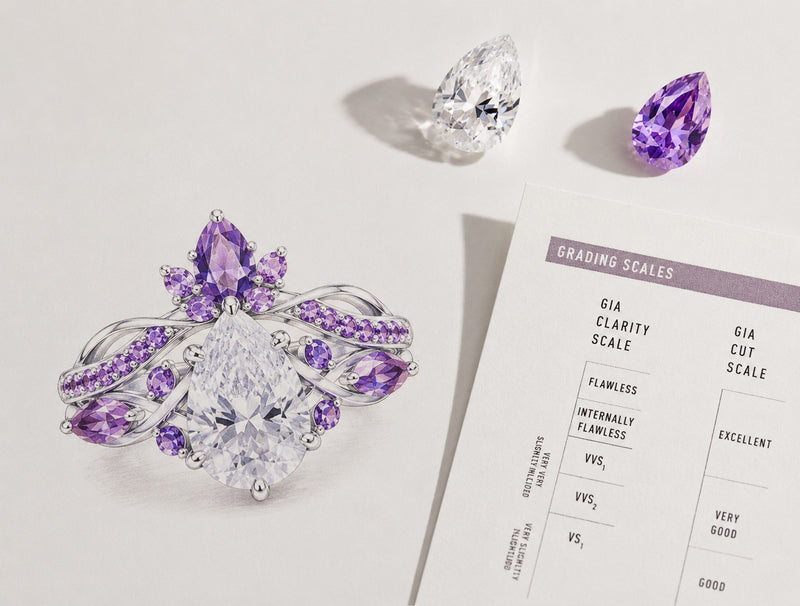
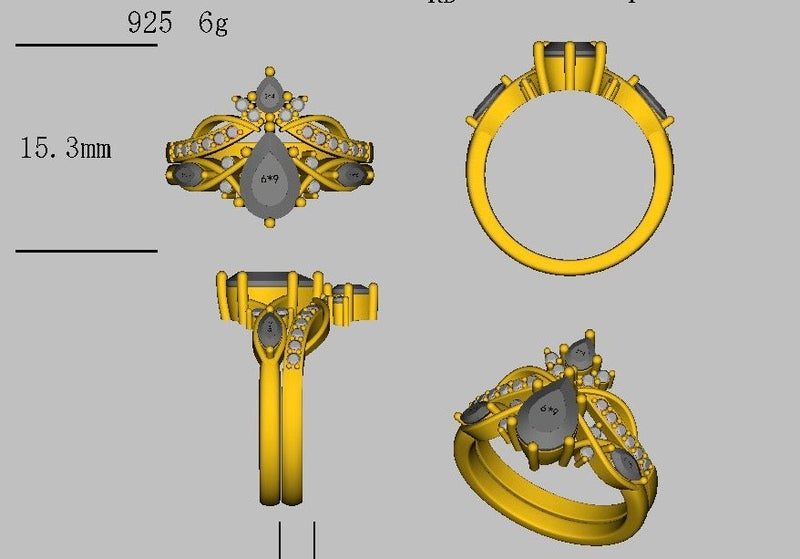
  2. See It in 3D: About a week later, we’ll send you a digital twin of your ring. This is a 3D CAD rendering that shows you every angle before a single piece of metal is melted. If you want to move a prong or tweak the band, this is the time. We keep going until it’s perfect, and once you give us the go, we get to work.
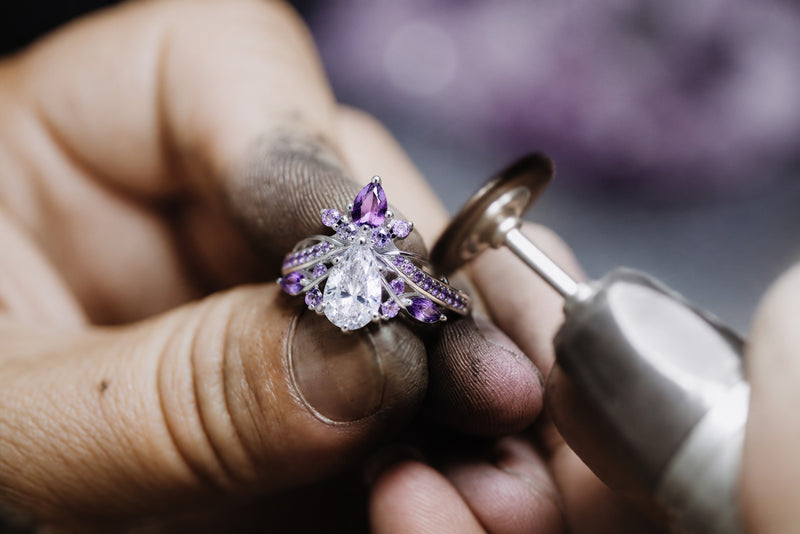
  3. The Build: Our bench jewelers take over, hand-casting your metal and setting your stones with old-school precision. We don’t leave you in the dark, either; you’ll get updates as your ring moves through the different stages of creation and passes our final quality checks.
  4. The Big Reveal: Your ring is tucked into our signature packaging and shipped via fully insured, trackable delivery that requires a signature. You’ll know exactly when it’s arriving, so you can plan that moment with total confidence.

Create Your Custom Engagement Ring Effortlessly at Aquamarise!

At the end of the day, an engagement ring is the only piece of clothing or jewelry you’ll ever buy that is intended to outlive you. It’s a heavy concept, but it’s also a beautiful one. Why leave that kind of legacy to a mass-produced mold when you have the chance to infuse it with your own style?

At Aquamarise, we believe that custom shouldn’t mean complicated. We’re here to take the stress out of the sketches and the guesswork out of the gemstones. Whether you have a fully-formed vision or just a vague feeling of what you want, we’re ready to help you bring it to life.

Ready to start your story? Don’t let your ideas stay stuck in a browser tab. Design your own engagement ring at Aquamarise today and build something that’s actually worth holding onto forever.

From the Blog

How to Build a Custom Engagement Ring: The Complete Step-By-Step Guide

How to Build a Custom Engagement Ring: The Complete Step-By-Step Guide

A custom engagement ring isn't just jewelry — it's a one-of-a-kind symbol crafted entirely around your love story. This complete guide covers everything: setting your budget, choosing a gemstone, selecting...

Read more
Promise Ring vs Engagement Ring: What's the Real Difference?

Promise Ring vs Engagement Ring: What's the Real Difference?

A promise ring and an engagement ring can look identical - but each tells a completely different love story. This guide covers what sets them apart, the history behind both...

Read more
How Long Does Custom Jewelry Take? A Step-by-Step Timeline for Custom Engagement Rings

How Long Does Custom Jewelry Take? A Step-by-Step Timeline for Custom Engagement Rings

Most custom Aquamarise® rings in solid gold or platinum take 3–6 weeks from design approval to delivery. Tungsten and titanium pieces typically take 3–8 weeks. Sterling silver and vermeil adjustments...

Read more
Moissanite vs Lab Diamond - Complete Comparison Guide

Moissanite vs Lab Diamond - Complete Comparison Guide

Moissanite and lab-grown diamonds look similar, but differ in sparkle, durability, and cost. Discover which one is the best choice for your ring.

Read more

Design Your Own Engagement Rings FAQs