


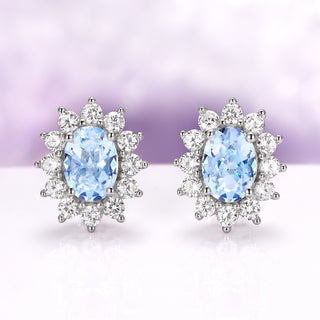


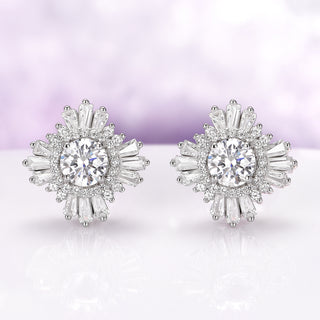


Earrings put a stone closer to the face than any other jewelry, and gemstone earrings live or die on that proximity: color, cut, and clarity all read at conversation distance, in every light a day contains. This collection is organized stone-first — sixteen stone types across natural, lab-grown, and simulated origins, each listing naming its origin and Mohs hardness — in studs, drops, dangles, and leverbacks across 925 sterling silver, 14K gold vermeil, black ruthenium, and solid 14K gold.
Gemstone Earrings Where the Stone Does the Talking
Settings here stay deliberately quiet so the mineral can speak. A kite cut turns moss agate's green landscape into sharp geometry; an oval opens a stone's face to show color at its broadest; a bezel frames softer stones while protecting their edges. The result is a collection that rewards choosing by stone first — hue, optical character, hardness — and by silhouette second. It is the order in which the eye actually reads a pair, and the order this page is built around.

Closest to the Face, Clearest in Color
Color is the first thing anyone notices at the earlobe, so hue is the fastest way in. Greens run from emerald's saturated depth to moss agate's one-of-one inclusions — the dedicated moss agate earrings page collects every design. Blues span icy aquamarine, velvety sapphire, and London blue topaz; our blue gemstones guide maps the whole family. Purples belong to amethyst and tanzanite, whose trichroic structure shows different tones as the light shifts through a day.
Blacks work differently: onyx is opaque, reflecting light from a polished surface rather than refracting it, which is why it suits sharp, architectural silhouettes. Pinks — morganite above all — carry a blush warmth that flatters at close range, while reds run from garnet's depth to ruby's saturated fire. Whatever the register, the stone's color is doing its work inches from your eyes, which is exactly where a good stone belongs.
From a Single Aquamarine Earring to a Full Spectrum
The stone this brand is named for makes the case for the whole category: one aquamarine earring worn as a simple stud shows why proximity matters, its icy blue-green reading clearly in a way no ring can manage. The full set of designs lives on the aquamarine earrings page. From there the spectrum opens out. Alexandrite earrings change color with the light source — green by day, red-violet by lamplight — precisely where people look during conversation. Moonstone glows and moves. Garnet and ruby hold the warm register; morganite the blush one. Formats stay consistent across all of them: flush studs for daily wear, drops with gentle movement, dangles for occasions, and hinged leverbacks that keep heavier stones secure through long evenings.

Natural, Lab-Grown & Simulated in Plain Terms
Every listing states its stone's origin. Natural stones formed in the ground over geological time and carry the small variations that prove it — no two natural pairs are truly identical. Lab-grown stones are the same mineral, optically and chemically, created in controlled conditions with cleaner clarity and friendlier prices. Simulated stones are look-alikes, and are labeled simulants rather than dressed up as something else. Mohs hardness is printed alongside, so you know before ordering whether a pair suits daily wear or deserves gentler rotation.
Metals follow the same honesty: solid 925 sterling silver, often rhodium-finished; 14K gold vermeil at the FTC minimum of 2.5 microns of 10K-or-finer gold over sterling; black ruthenium's smoked near-black; and made-to-order solid 14K gold stamped 585. For night-sky romantics, the celestial register — stars, moons, and scattered stones set like constellations — has its own styling guide worth reading before you choose.
Gemstone Earrings vs the Main Earring Collection
This page is the stone-first sort: come here when the mineral matters more than the silhouette, to compare hues, origins, and hardness side by side. The master earrings collection is the wider door — every pair we make, including motif-led designs where the metalwork or the shape, not the stone, carries the piece. Same workshop, same hands, two ways of sorting the work.
Worn Close, Chosen Well
A stone worn at the earlobe is the most personal way to wear color — visible to everyone she talks to, chosen for reasons that might be entirely private. Every pair is handmade to order in recycled precious metals, matched as a pair by hand, and shipped worldwide with insured delivery, luxury gift packaging, and a 14-day return window on non-customized pieces. We hold a 4.9-star average across 38,000+ reviews collected on our store and on Etsy, where we have sold since 2016.
From the Journal

Celestial & Star Earrings: A Guide to Cosmic Style
A guide to celestial and star earrings: cosmic and star styles, the gemstones that shimmer like the night sky, signature Orion Nebula and Starry Night® designs, and how to style...

Gothic Earrings: A Dark Romantic Style Guide
A guide to gothic earrings: what defines dark-romantic style, black onyx and dark gemstones, gothic earring styles from studs to drops, and how to style and care for them.

Purple Gemstones: Names, Meanings, Hardness & Value
From everyday amethyst to rare tanzanite — the complete guide to 15 purple gemstones, what they mean, how durable they are, their value, and how to choose one for a...

Blue Gemstones: The Complete Guide to Every Shade & Stone
From royal sapphire to sea-blue aquamarine and bright blue topaz — every blue gemstone worth knowing: what makes them blue, what they mean, how hard they are, and the best...
Gemstone Earrings FAQs
“These earrings are beautiful. They are eye catching. I love them.”
“The earrings are exceptionally beautiful! I really like the way they sparkle.”
“These became our wedding rings! The stones are amazing and very beautiful!”
“Fits perfectly, looks amazing and the engraving is super cute!”