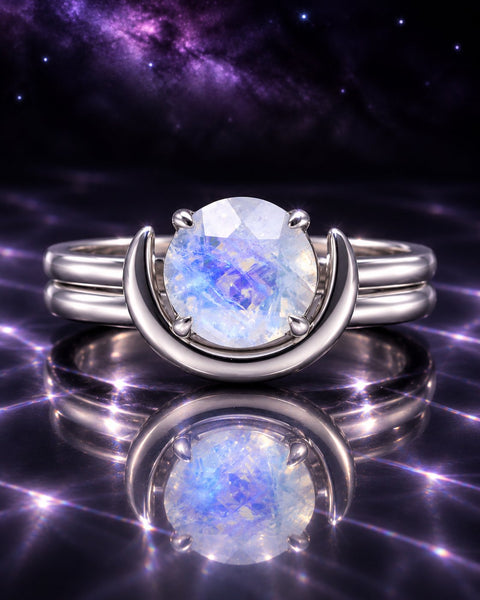
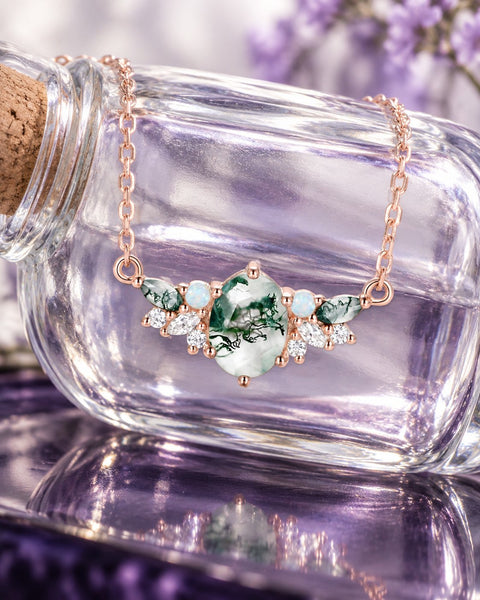
An Art Deco three-stone engagement ring in gold. A 6 × 12 mm marquise lab-grown alexandrite sits north to south in six prongs, with a natural black onyx baguette flanking each side and two round simulated diamonds stepping down each shoulder. 14K yellow gold vermeil over solid 925 sterling silver.
Lab-Grown Alexandrite
Marquise Cut, 6 × 12 mm
Black Onyx Baguettes
Three-Stone Setting
14K Yellow Gold Vermeil
Sizes 4–11
The Design
A long marquise set point-up along the finger, with a vertical black baguette on either side and a pair of round white stones beyond each one, so the ring reads as a tapering line of five stones with the black acting as a frame around the color-change center. The shank is slim and straight with a plain polished back, so the line of stones is the whole ring. The black baguettes are the Deco part: a hard graphic edge between the shifting alexandrite and the white sparkle of the shoulders.
Our marquise engagement rings guide covers why the cut reads larger and longer than its carat weight, alexandrite engagement rings covers the stone as a center, and vintage engagement rings covers the Deco lane this ring sits in. For the wider field, non-traditional engagement rings.
The Alexandrite
The center is lab-grown alexandrite, grown as chrysoberyl with the same chemistry and 8.5 Mohs hardness as the mined stone. Alexandrite is the color-change gem: this one reads teal-green to blue under daylight and shifts toward violet and raspberry under warm indoor light, and the long marquise shows both colors at once as the light crosses it. Our alexandrite guide and does synthetic alexandrite change colors cover what to expect from the shift, lab-grown vs natural alexandrite explains the difference, and alexandrite meaning covers its history. Alexandrite is a June birthstone; the June birthstone guide has more.
Metal and Stones
The ring is 14K yellow gold vermeil: real 14K gold over solid 925 sterling silver. The warm gold pulls the green out of the alexandrite in daylight and the raspberry out of it at night. Our guide to caring for vermeil jewelry covers the finish, and what is gold vermeil explains what sets vermeil apart.
The center marquise is lab-grown alexandrite. The two baguettes are natural black onyx, and the four small round stones are simulated diamond (cubic zirconia). Our moissanite vs cubic zirconia post explains what that material does well and where it falls short of a mined stone; moissanite or lab-grown diamond rounds are available as a custom order.
Part of our alexandrite engagement rings, marquise engagement rings, three stone engagement rings, antique and vintage engagement rings and June birthstone collections, alongside the rest of our yellow gold vermeil rings and black gemstone jewelry.
Aquamarise vermeil is real gold over sterling silver 925, the rich golden look you love at a price that makes it easy to say yes. Keep it luminous with a little care: remove before showering, swimming or exercise, avoid contact with lotions and fragrance, and store dry between wears.
Specifications
-
Center stone: Lab-grown alexandrite, marquise cut, 6 × 12 mm
-
Side stones: Two natural black onyx baguettes
-
Accent stones: Four simulated diamond (cubic zirconia) rounds
-
Metal: 14K yellow gold vermeil over solid 925 sterling silver
-
Setting: Six-prong marquise, north to south; channel-set baguettes; straight shank
-
Hardness: Alexandrite 8.5, onyx 6.5 to 7, cubic zirconia 8 to 8.5 on the Mohs scale
-
Birthstone: June
-
Sizes: 4 to 11, including half sizes
-
Engraving: Available, up to 16 characters
-
Presentation: Free luxury velvet jewelry box
Care
Alexandrite is 8.5 on the Mohs scale and suits daily wear; the onyx baguettes are softer and porous, so keep the ring away from bleach and solvents. Clean with warm water, mild soap and a soft brush, working the brush along the shoulders where lotion collects, then dry before storing. No silver polishing cloths or abrasive compounds, which thin the gold vermeil; avoid ultrasonic cleaners, chlorine and household chemicals for the same reason. Take the ring off for the gym, swimming and heavy cleaning, keep the marquise points clear of hard knocks, and store it in its box rather than loose.
Frequently Asked Questions
Is the alexandrite real?
It is lab-grown alexandrite: real chrysoberyl with the same chemistry and color change as the mined stone, grown in a lab rather than dug up. It is not a simulant.
Does it change color?
Yes. The marquise reads teal-green to blue in daylight and shifts toward violet and raspberry under warm indoor light. The change is a shift in tone, not a switch between two unrelated colors.
What are the black stones?
Natural black onyx, cut as baguettes and set vertically on either side of the center. The four small white stones are simulated diamond, which is cubic zirconia.
How big is the center stone?
6 × 12 mm, marquise cut, held in six prongs with the points running along the finger.
Is alexandrite a birthstone?
Yes. Alexandrite is one of the June birthstones.
Is alexandrite durable enough for everyday wear?
Yes. At 8.5 on the Mohs scale it is harder than everything except sapphire, moissanite and diamond. The onyx and the gold vermeil finish are the parts to look after.
Is it real gold?
Yes. The ring is 14K yellow gold vermeil: a layer of real 14K gold over a solid 925 sterling silver core. There is no brass or base metal under it.
Will it turn my skin green?
No. The core is solid sterling silver and the surface is real gold, so there is no copper alloy to react with skin.
What are the small white stones?
Simulated diamond, which is cubic zirconia. We name it plainly: it is not diamond and not moissanite. Moissanite or lab-grown diamond accents are available as a custom order.
Can I stack it with a band?
Yes. The shank is straight and slim, so a plain or pavé band sits against it on either side.
What sizes are available?
Sizes 4 through 11, including every half size.
Can I have it engraved?
Yes. Engraving is available on the inner band, up to 16 characters, and can be added as an option at checkout.
How do I care for the vermeil?
Put the ring on last, after lotion and fragrance, and take it off for swimming, showering and the gym. Clean with warm water, mild soap and a soft brush, never a silver polishing cloth or an ultrasonic cleaner, and store it dry in its box.
Are the stones ethically sourced?
Yes. All Aquamarise stones are conflict-free and responsibly sourced, and every order arrives in a free luxury velvet jewelry box.