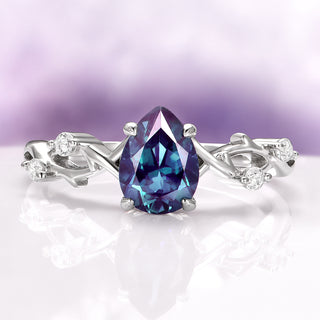
One stone, two moods. The oval at the center of this color-changing alexandrite engagement ring glows teal and green in daylight, then slips into violet and purple-red under indoor and candlelight — a genuine color-shift you can watch happen on your hand. Flanked by two pear-cut side stones and set high in 925 sterling silver with a rhodium finish, the faceted alexandrite is open to the light, so the change is always on display rather than hidden away.
Visible color-shift
Oval center, pear sides
Lab-created alexandrite
Solid 925 sterling silver
Rhodium finish
June birthstone
A three-stone silhouette
An oval center with two pear-shaped side stones is one of the most romantic layouts in jewelry — the trio is often read as past, present and future. Here the pears angle inward like petals, guiding the eye to the alexandrite and lending the ring a luminous, elongating line on the finger. It is a classic setting given an unexpected heart, and it sits right at home among our alexandrite engagement rings. Love the color and want it beyond a ring? Our alexandrite necklaces carry the same shift-in-the-light magic.
The color-shift explained
Alexandrite changes color because trace chromium in the crystal absorbs yellow-orange light. Under blue-rich daylight or fluorescent light the oval reads teal and green; under red-rich incandescent bulbs or candlelight the very same stone reads violet and purple-red. This is a faceted, open-set center — not crushed stone under resin — so the shift is visible in real time as you move from room to daylight to evening. To see how faithfully a created stone reproduces the effect, read our journal on whether synthetic alexandrite changes color.
The lab-created alexandrite center
The 7 x 9 mm oval (approximately 1.9 ct) is lab-created alexandrite — the same chromium-traced chrysoberyl as mined alexandrite, matching it in composition, hardness and color-changing optics, grown in a lab instead of the earth. Because natural alexandrite of this size is among the rarest and most expensive gems in existence, a lab-created center is what puts a bold color-changer within reach. Our guide to lab-grown vs natural alexandrite spells out exactly what shoppers should know.
Simulated diamond accents
Beyond the pear alexandrite sides, the design is lifted with simulated diamond (CZ) accents that throw a crisp, bright sparkle around the center — a clean, brilliant flash that makes the alexandrite’s shifting color read even more vividly. It is an accessible way to add classic engagement-ring shimmer, and it pairs effortlessly with the color-change at the center. Prefer moissanite or natural-diamond accents instead? Just reach out.
Solid sterling silver with a rhodium finish
The ring is crafted in solid 925 sterling silver with a rhodium finish — the same white metal used on fine white gold. The finish gives a bright, mirror-white luster and a protective shield that helps resist tarnish and everyday scratches, so the silver keeps looking freshly polished. Its cool white tone is also the ideal neutral setting for alexandrite, letting both the teal and the violet read at full strength.
What alexandrite symbolizes
A stone that transforms with the light is a graceful emblem for love that adapts and deepens over time — long associated with transformation, balance and new perspective. As one of the three traditional June birthstones, it also makes a heartfelt June birthday gift. Deciding between this and another blue-violet classic? Our comparison of alexandrite vs sapphire explains why the color-change gives alexandrite its one-of-a-kind character.
Specifications
-
Metal Solid 925 sterling silver with rhodium finish
-
Center stone Lab-created alexandrite (color-changing)
-
Shape Oval
-
Stone size 7 x 9 mm (approx. 1.9 ct)
-
Color-shift Teal / green in daylight, violet in warm light
-
Side stones Pear-cut accents
-
Accents Simulated diamond (CZ)
-
Hardness Alexandrite 8.5–9 on the Mohs scale
-
Band width Approx. 1.7 mm
-
Fit True to size
-
Included Free luxury velvet gift box & lifetime warranty
Sizing & care
This ring runs true to size — choose yours at checkout, and if you’re between sizes or unsure, contact us for guidance. To keep the color-shift vivid and the rhodium bright, remove the ring before showering, swimming or applying lotions, store it in its velvet box, and buff gently with a soft dry cloth. At 8.5–9 Mohs the alexandrite is tough enough for confident everyday wear.
Frequently asked questions
Does the alexandrite really change color?
Yes. The faceted oval reads teal and green in daylight and shifts to violet and purple-red under warm indoor light or candlelight. Because it is set high and open rather than in resin, the color-shift is genuinely visible as your lighting changes.
What causes the color change?
Trace chromium inside the crystal absorbs yellow-orange wavelengths. Blue-rich daylight leaves the stone reading teal-green, while red-rich indoor light leaves it reading violet. It is the same effect seen in natural and lab-created alexandrite.
Is the alexandrite genuine?
Yes — it is real lab-created alexandrite, identical to mined alexandrite in composition, hardness (8.5–9 Mohs) and color-changing optics. It was grown in a laboratory rather than mined, which is the only difference.
Why lab-created rather than natural?
Natural alexandrite of this size is one of the rarest and most expensive gems on earth. A lab-created center delivers the same color-shift, brilliance and durability at a fraction of the cost, making a bold color-changer like this attainable.
What are the side and accent stones?
Two pear-cut accents flank the oval, with additional simulated diamond (CZ) accents adding crisp brilliance. The bright white sparkle frames the alexandrite and makes its shifting color read more vividly. Moissanite or natural-diamond upgrades are available on request.
What does the three-stone layout mean?
An oval center with two side stones is often read as past, present and future — a romantic symbol of a shared journey. It also creates a luminous, elongating line across the finger.
What metal is it made from?
Solid 925 sterling silver finished with rhodium, the same white metal used on fine white gold, for a bright luster and added protection.
What does the rhodium finish do?
Rhodium gives the silver a mirror-white, white-gold-like shine and adds a protective layer that helps resist tarnish and scratches, keeping the ring looking freshly polished.
Will it tarnish or turn my skin green?
No. Genuine 925 sterling silver with a rhodium finish resists tarnish and won’t discolor your skin under normal wear. Remove it before swimming or applying lotions to keep it at its brightest.
Is alexandrite durable enough for daily wear?
Yes. At 8.5–9 on the Mohs scale it is one of the hardest colored gems used in engagement rings, just below ruby and sapphire, so it holds up well to everyday wear with normal care.
Is alexandrite a June birthstone?
Yes — it is one of the three traditional June birthstones, which makes this ring a meaningful June birthday gift as well as an engagement, promise or anniversary piece.
Are the stones ethically sourced?
Yes. All of our stones are ethically sourced and conflict-free, so you can wear the ring with complete peace of mind.
Does it arrive gift-ready?
Every order ships in a free luxury velvet gift box with a lifetime warranty. Explore matching pieces in our alexandrite jewelry collection.