


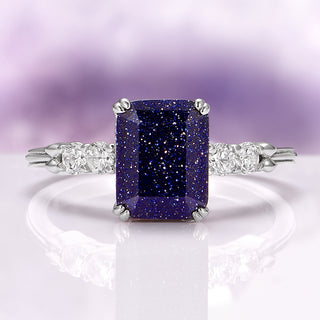
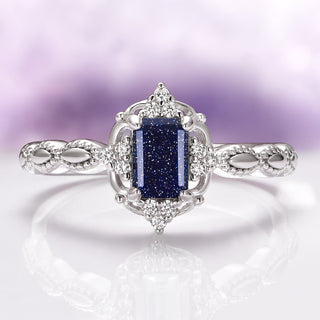
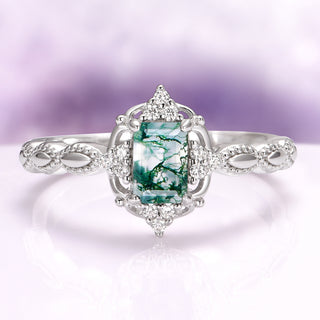
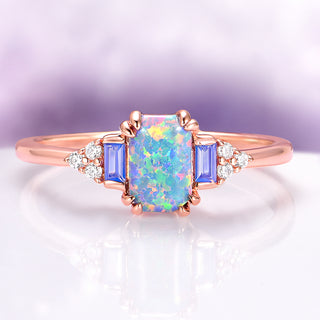

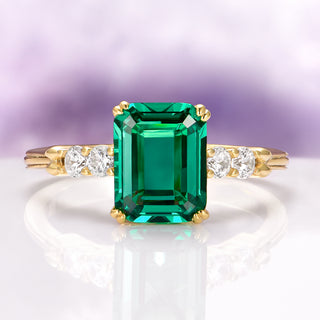
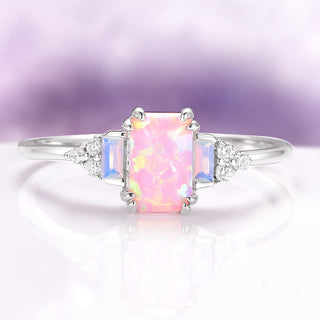
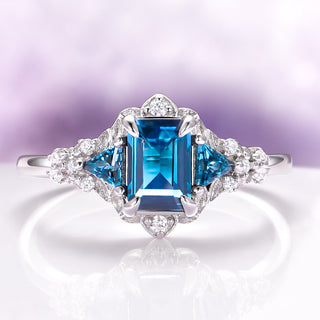
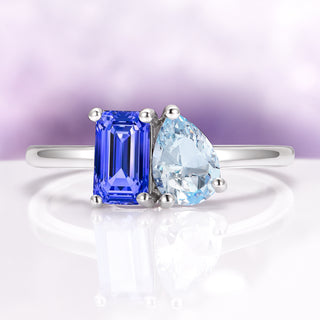

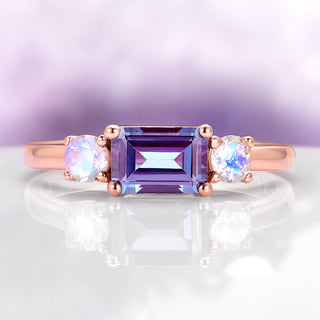

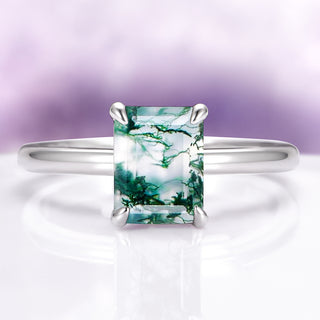
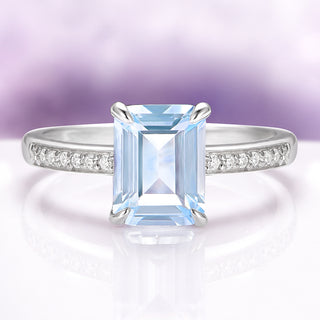
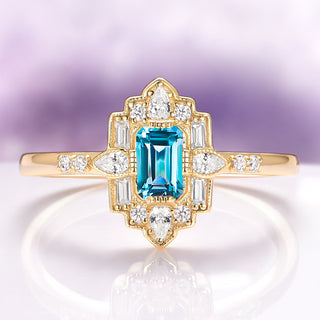
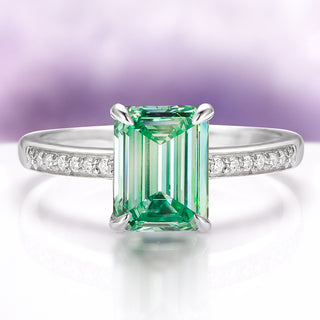
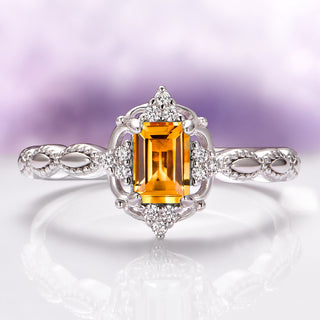
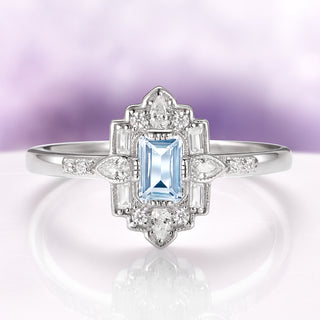
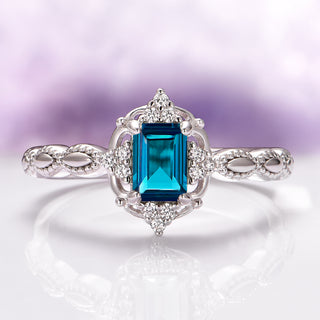


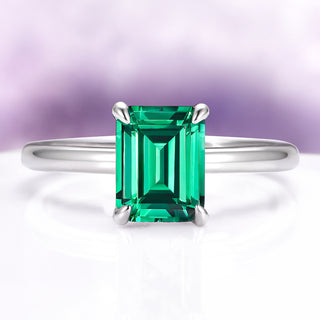

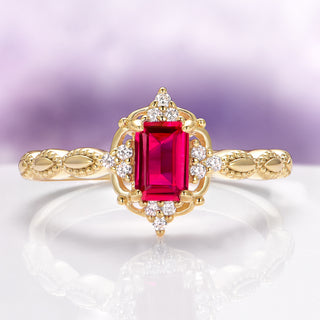
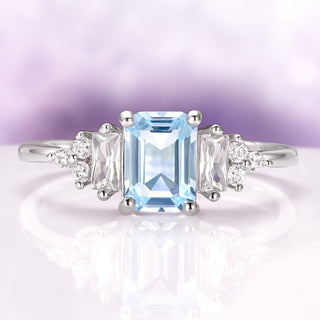


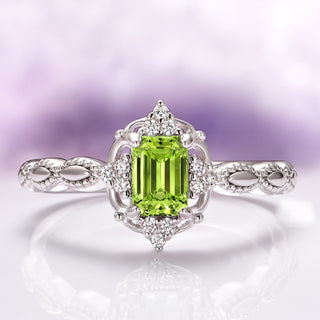
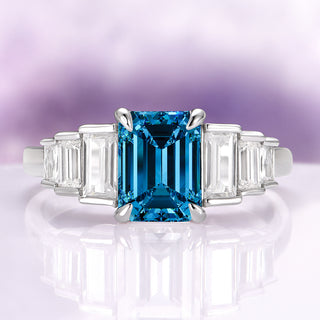
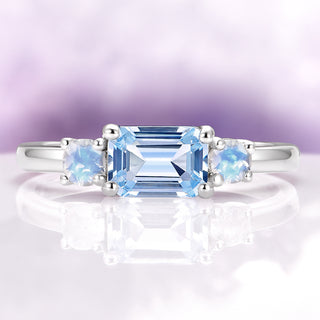


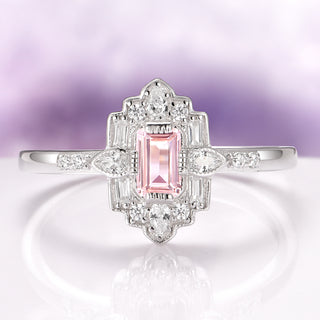
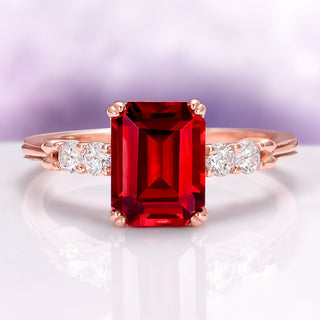

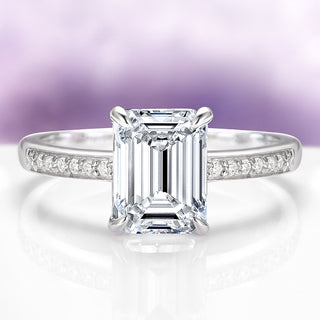


Emerald cut engagement rings are built on a different theory of beauty than every brilliant cut. Instead of scattering light into sparkle, the stepped, parallel facets and trimmed corners return light in long, clean flashes — the “hall of mirrors” effect — putting the stone’s color and clarity on open display. It is the cut of the Art Deco 1920s and of Grace Kelly’s 10.48-carat Cartier diamond, and in this collection it frames not just diamond but aquamarine, moissanite, sapphire, morganite, moss agate, and London blue topaz — hand-finished in sterling silver, 14K gold vermeil, and solid 14K gold.
What Makes Emerald Cut Engagement Rings the Most Architectural Choice
The emerald cut is a step cut: rectangular outline, corners cropped into an octagon, and facets arranged in parallel terraces rather than triangular kites. The result reads as architecture — long lines, symmetry, restraint. Where a round brilliant performs, an emerald cut composes. The classic length-to-width ratio runs from about 1.30 to 1.50, elongating the finger, and because the cut’s broad open table hides nothing, it favors stones with genuine clarity — which is exactly why it suits the clean modern gem materials this collection is built on.

The Hall-of-Mirrors Effect: How This Cut Handles Light
Brilliant cuts maximize scintillation — hundreds of small flashes. Step cuts maximize what jewelers call the hall of mirrors: broad planes of light and dark that slide across the stone as the hand moves. In a colored stone, those planes carry the color in sheets, which is why an emerald cut aquamarine or sapphire looks deeper and more saturated than the same stone cut round.
In a high-refraction stone like moissanite — refractive index higher than diamond’s — the effect turns liquid, with mirror flashes edged in fire. Neither approach is better; they are different instruments. This collection is for the composed one.
There is a practical consequence, too. Because the light moves in planes rather than pinpoints, an emerald cut reads clearly across a room and photographs with unusual definition — the silhouette stays crisp where a brilliant cut dissolves into sparkle. It is the shape that looks most deliberate on the hand, and the one other people can identify at a glance.
Emerald Cut Engagement Rings by Stone: Aquamarine, Moissanite, Sapphire & Beyond
An emerald cut aquamarine engagement ring is the collection’s signature — the Ava and Amelia designs set icy blue-green beryl in step-cut form, and the pairing is historically natural: aquamarine and emerald are the same mineral family, and the cut was developed for beryl’s long crystals. Browse the wider aquamarine engagement rings range for every shape.
Alongside them sit emerald cut rings in moissanite, mint and white sapphire, blush morganite, botanical moss agate, London blue topaz, and IGI-certified lab-grown diamond. One shape, a full spectrum of stones and prices — and because the open table reveals clarity dramatically, every listing names its stone and tier plainly.

Art Deco Roots — a Century of Style
Step cutting is old — Renaissance table cuts worked the same way — but the emerald cut as we know it was refined in the 1920s, when Art Deco taste demanded geometry, and the name became standard trade language by the 1940s. Its wearers tell the history: Grace Kelly’s 10.48-carat Cartier ring in 1956, Amal Clooney’s seven-carat ring, Mariah Carey’s 35-carat ring, and Beyoncé’s famously reported 18-carat stone.
The design language that grew up around the cut is its own reward. Stepped shoulders continue the stone’s terraces into the band; baguette side stones repeat its parallel facets in miniature; milgrain edging frames the geometry the way a plaster ceiling frames a room. These details are why an emerald cut ring so often reads as an heirloom on first wearing — the vocabulary predates every current trend and will outlast them.
Our Art Deco and vintage-styled settings draw directly on that lineage, and pair naturally with the wider emerald cut jewelry range of necklaces and earrings — the same step-cut geometry, carried past the ring.
Choosing Proportions & Settings That Flatter
Three practical rules. First, ratio: 1.30–1.50 is the classic window — longer reads dramatic, squarer reads vintage. Second, orientation: a north-south stone elongates the finger; an east-west setting turns the same stone contemporary. Third, protection: the trimmed corners that make the cut durable still deserve prongs or a bezel at the corners, and hidden-halo settings add sparkle underneath without interrupting the clean top view. Compare solitaires, hidden halos, and vintage settings — or, if you love the long silhouette with more geometry, the radiant cut, the hexagon, and the angular kite cut.
Emerald Cut vs Emerald Stone — the Difference That Matters
“Emerald” here names the shape, not the gem. Every ring on this page is emerald cut; only some contain the green stone. If you are searching for the green gemstone itself — natural, lab-grown, or simulated green beryl in any shape — that is our emerald engagement rings collection. An emerald-cut emerald, the configuration Grace Kelly made canonical, appears in both.
Every Aquamarise ring is hand-finished and ships worldwide with insured delivery, complimentary engraving, and a 14-day return window on non-customized pieces. We hold a 4.9-star average across 38,000+ reviews collected on our store and on Etsy, where we have sold since 2016. For a stone-and-setting combination you don’t see here, use the custom ring service.
From the Blog

Emerald Cut Engagement Rings: The Complete Buying Guide
Everything about emerald cut engagement rings: why the step cut creates the hall-of-mirrors look, why clarity matters far more than in a brilliant, the ideal length-to-width ratio, what they really...

Emerald Engagement Rings: The Complete 2026 Buying Guide
Emerald is a bold, romantic engagement stone — vivid green, rich in meaning, but softer than sapphire. Our 2026 guide covers color and the jardin, durability, the emerald cut, protective...

Marquise Engagement Rings: The Complete Guide to the Most Elongating Shape
Regal, dramatic, and the shape that looks biggest for its carat. A jeweler's complete marquise guide — the history, the bowtie effect, the best length-to-width ratio, the settings that protect...

How to Build a Custom Engagement Ring: A Step-by-Step Guide
A jeweler's step-by-step guide to designing a custom engagement ring — from budget and center stone to setting, metal, CAD approval, timeline, and what a custom ring really costs.
Emerald Cut Engagement Rings FAQs
“This ring exceeded my expectations in every way. The craftsmanship is impressive, with a more substantial feel than I anticipated from the photos.”
“The ring is just as beautiful in person as it is in the pictures. It's the perfect size for me also.”
“This ring is beautiful. I love everything about it.”
“This ring is so much more beautiful in person.”