Free U.S. Shipping
Dispatched from the USA with care
Hustle-Free Returns & Exchanges
Simple, worry-free process
Ethically Crafted
Responsibly sourced, consciously made
Loved by 200,000+ Couples
Fantasy-inspired, handcrafted jewelry
Why Amethyst Works as an Engagement Stone
Three reasons amethyst has grown as an engagement ring stone over the past decade, beyond simple color preference.
The color is genuinely rare in fine jewelry. Most colored gemstones used in engagement rings fall into red, blue, green, or yellow ranges. Pure saturated purple is uncommon — alternatives at the same color depth include purple sapphire (significantly more expensive), tanzanite (color-zoned and fragile), or color-change garnet (rare and harder to source). Amethyst is the most accessible genuinely purple gemstone available at scale, which makes it the natural choice for buyers drawn to purple specifically.
It's hard enough for daily wear. Amethyst ranks 7 on the Mohs hardness scale — the same as quartz (which it is, technically), tourmaline, and topaz, and just slightly below sapphire (9), moissanite (9.25), and diamond (10). At Mohs 7, amethyst handles daily wear well in protective settings, though it benefits from awareness about heavy impact and abrasive environments. For an engagement ring intended to be worn for decades, Mohs 7 is the practical threshold below which we don't recommend most stones — amethyst sits exactly at that threshold.
The price-to-presence ratio is exceptional. A 1-carat amethyst typically costs a small fraction of an equivalent sapphire, less than half of a comparable lab-grown diamond, and meaningfully less than tanzanite or alexandrite. Combined with the cut's typically generous size (amethyst is often cut larger than equivalent-priced harder stones because the rough material is more abundant), an amethyst engagement ring delivers visible color presence at a price point that most other colored gemstones can't match.
What Amethyst Means in an Engagement Context
Amethyst carries one of the longer documented symbolic histories of any gemstone used in modern engagement jewelry. The name comes from the Ancient Greek amethystos — "not intoxicated" — based on the Greek belief that the stone protected its wearer from drunkenness and the impaired judgment that accompanied it. By extension, amethyst became associated with clarity of thought, sober reflection, and protection against confusion.
In medieval Europe, amethyst was considered one of the cardinal gemstones (along with diamond, sapphire, ruby, and emerald) and was reserved primarily for royalty and high clergy. Bishops wore amethyst rings as symbols of spiritual authority and divine clarity. The association with purple and royalty cemented the stone's place in Western symbolic tradition for over a millennium.
In contemporary engagement ring contexts, amethyst's symbolism has narrowed and personalized. The most common interpretations couples bring to amethyst engagement rings:
- Clarity in commitment — choosing amethyst signals a deliberate, considered decision rather than a default convention. The "not intoxicated" Greek root resonates with couples who want their engagement to read as sober reflection rather than impulse.
- February birthstone significance — amethyst is the official February birthstone, which makes amethyst engagement rings particularly meaningful for February-born partners or for relationships with significant February dates.
- Spiritual or intuitive partnership — for couples who connect through shared spiritual practice, meditation, or contemplative traditions, amethyst's long association with these qualities makes it the gemstone-of-record.
- Quiet distinctiveness — amethyst reads as deliberate without reading as flashy. It signals that the wearer chose something specifically rather than accepting a default expectation.
For deeper birthstone context across all twelve months, see our birthstones by month guide.
Amethyst Engagement Ring Styles
Amethyst Solitaire Engagement Ring
The simplest configuration: a single amethyst center stone in a clean band, no accent stones. Solitaire settings work particularly well with amethyst because the stone's saturated purple color carries the entire ring visually — nothing competes for attention. Most amethyst solitaires use four-prong or six-prong settings that maximize the visible stone surface and let the most light reach the gem.
For broader solitaire engagement options across stones, see solitaire engagement rings.
Amethyst Halo Engagement Ring
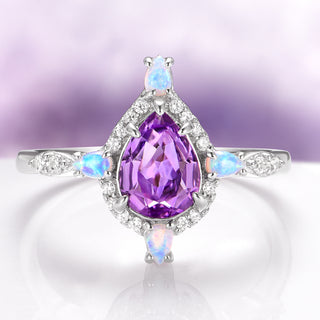
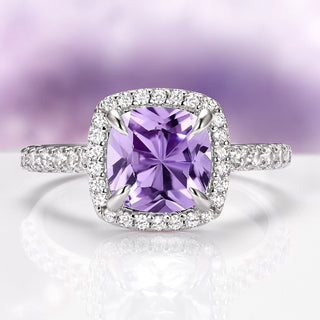
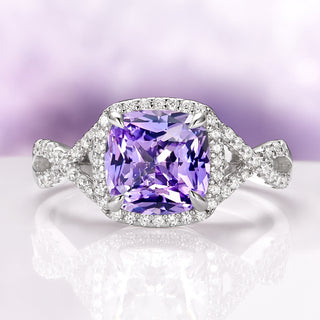
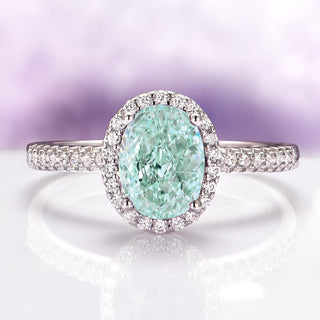
A halo setting surrounds the amethyst center stone with smaller accent stones — typically lab-grown diamonds, moissanite, or coordinated colored gemstones. The halo amplifies the visible scale of the ring and creates dramatic color contrast where bright accent stones surround the deeper purple center. Halo configurations work especially well for amethyst because the cool brilliant white of accent stones makes the purple read as more saturated and intense by comparison.
For broader halo engagement ring options, see halo engagement rings.
Amethyst Hidden Halo Engagement Ring
A hidden halo places small accent stones beneath the amethyst's girdle, visible only when the ring is viewed from the side. From directly above, the ring reads as a clean amethyst solitaire. As the wearer's hand moves, the hidden accents catch light from new angles and reveal additional brilliance the face-on view doesn't suggest.
See the broader hidden halo engagement rings collection.
Amethyst Three-Stone Engagement Ring
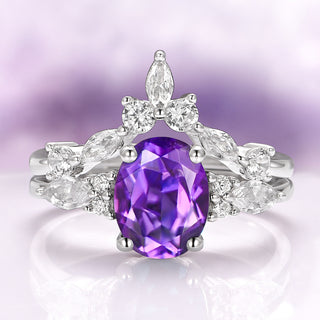
Three-stone settings flank the amethyst center stone with two smaller accent stones on either side, traditionally interpreted as representing the past, present, and future of a relationship. For amethyst configurations specifically, two patterns work well: matching smaller amethyst side stones (creates color continuity) or contrasting white accent stones in moissanite or lab-grown diamond (plays the saturated purple against neutral brilliance for stronger visual impact).
Vintage and Art Deco Amethyst Engagement Rings
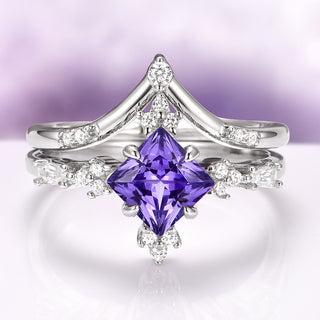
Amethyst has one of the strongest historical associations with vintage and Art Deco jewelry of any gemstone — the stone's prominence in Victorian, Edwardian, and 1920s-1940s fine jewelry means an amethyst engagement ring in a vintage-inspired setting carries authentic period referencing rather than recreated aesthetics. Milgrain detailing, symmetrical side stones, and geometric metalwork all suit amethyst particularly well because they echo the design vocabulary of the eras when amethyst was at its peak popularity.
For broader vintage options, see vintage antique engagement rings.
Nature-Inspired and Fairy Amethyst Engagement Rings
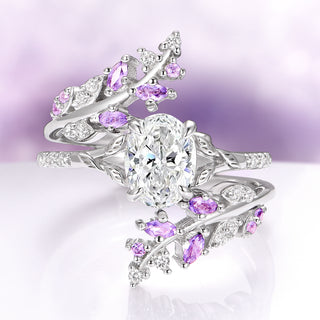
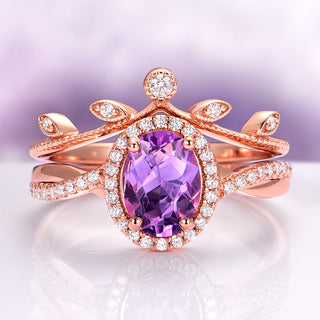
Amethyst's deep purple color reads particularly well against organic leaf, vine, and botanical setting motifs because purple sits naturally within the floral color palette (think wisteria, lavender, lilac, violet). Amethyst leaf and fairy-style settings produce a distinctive aesthetic that combines color saturation with organic form — particularly suited to buyers drawn to fantasy or romantic-period design references.
For nature-inspired and fairy settings, see nature-inspired engagement rings, fairy engagement rings, floral engagement rings, and leaf engagement rings.
Metal Options for Amethyst Engagement Rings
The metal choice matters more for amethyst than for many engagement stones because purple interacts visibly differently with cool versus warm metal tones.
Sterling Silver Amethyst Engagement Rings
925 sterling silver is the most accessible metal in this collection — genuine precious metal, fully resizable and repairable. Silver's cool tone is the traditional setting for amethyst because the cool metal allows the stone's purple to read at full saturation without being shifted by warm metal influence. Silver also references the stone's medieval and Victorian setting traditions, making it the most historically authentic choice for vintage-inspired amethyst designs.
For the broader silver engagement range, see sterling silver engagement rings.
Gold Vermeil Amethyst Engagement Rings
Gold vermeil — sterling silver with a thick gold electroplated layer — delivers the gold aesthetic at a fraction of solid gold's price.
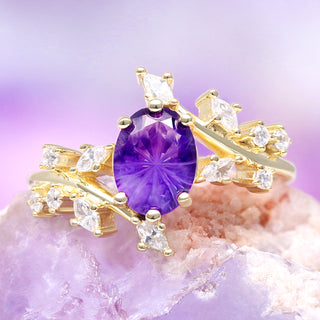
Yellow gold vermeil creates striking warm-cool contrast against amethyst's purple, producing a regal, vintage-Mediterranean aesthetic. The combination is one of the most historically referenced in fine jewelry, dating to medieval and Renaissance amethyst settings. Rose gold vermeil softens amethyst's intensity into a more romantic register, with the warm pink metal creating subtler tonal variation than yellow gold's stronger contrast. White gold vermeil keeps amethyst reading at full saturation similar to silver, with slight warmth from the gold layer underneath.
See the broader gold vermeil jewelry, yellow gold vermeil jewelry, and rose gold vermeil rings collections.
Solid 14K Gold Amethyst Engagement Rings
The premium tier within the collection: solid 14K gold throughout the entire ring — gold alloy, no plating. Available in yellow, rose, and white gold. Solid 14K gold amethyst engagement rings are the choice for buyers who want permanent gold material value alongside amethyst's color presence. Heirloom-grade. Fully repairable. Holds material value across decades.
For the broader solid gold engagement range, see solid gold engagement rings.
Black Ruthenium Amethyst Engagement Rings
For alternative, gothic, or dark-romantic aesthetics, black ruthenium plating over sterling silver creates dramatic contrast that makes amethyst's purple read more saturated and luminous against the dark metal. The combination is particularly striking for buyers drawn to gothic or fantasy-inspired engagement aesthetics.
See lovers of the dark™ black engagement rings and gothic engagement rings.
Choosing Your Amethyst — Color, Cut, and Clarity
Three factors define an amethyst's quality and how it presents in an engagement ring setting.
Color
is the most important. The most desirable amethyst displays a deep, saturated purple with hints of red flashes under direct light — what gem traders call "Siberian" amethyst (a stylistic designation, not a sourcing one). Lighter amethyst reads as lavender or violet; darker amethyst can appear nearly black under low light. For engagement ring use, the medium-to-deep saturation range (sometimes called "Deep Russian" or "Uruguayan") provides the strongest visual presence without crossing into too-dark territory where the color disappears in dim conditions.
Cut
affects how the color displays. Faceted brilliant cuts (round, oval, cushion, pear) maximize light return and sparkle. Step cuts (emerald, Asscher) emphasize the stone's color clarity and show the purple as flat broad planes rather than bright sparkle. For amethyst engagement rings, brilliant cuts are more common and produce more visual energy; step cuts produce more architectural restraint.
Clarity
matters less for amethyst than for colorless stones, but quality amethyst is generally eye-clean with no visible inclusions to the naked eye. Lower-grade amethyst can show internal banding or color zoning where the purple intensity varies across the stone — this is acceptable in casual jewelry but unsuitable for engagement rings, where color uniformity contributes to the stone's perceived quality.
Matching Wedding Bands for Amethyst Engagement Rings
Amethyst engagement rings pair particularly well with three wedding band styles:
Plain solid gold or silver band — the simplest pairing, lets the amethyst remain the visual focus. Works particularly well with solitaire amethyst engagement rings.
Diamond or moissanite eternity band — small accent stones in a continuous band around the wedding ring, providing brilliant white contrast against the purple center stone and amplifying the visible jewelry presence.
Coordinated amethyst-accent band — a wedding band with smaller amethyst accent stones that echo the engagement ring's center color. Less common but striking when paired with amethyst halo or three-stone engagement settings.
For matching wedding bands, see solid gold wedding bands, sterling silver women's wedding bands, and curved wedding bands. For coordinated engagement-and-wedding sets, see couples engagement ring sets, couples wedding ring sets, and wedding ring sets for women.
From the Blog
Purple Gemstones: The Complete Guide to 13 Names, Meanings, Hardness & Value
From the imperial purple of murex sea snails to the violet fire of Tanzanian zoisite — an expert journey through 13 purple gemstones. Amethyst, lavender sapphire, tanzanite, charoite, kunzite &...
Promise Ring Meaning: The Complete Guide to Symbolism, History & Purpose
What does a promise ring actually mean? Not the marketing answer — the real one. A complete expert guide to promise ring symbolism, history, cultural meaning, and the different commitments...
Promise Ring vs Engagement Ring: What's the Real Difference?
A promise ring and an engagement ring can look identical - but each tells a completely different love story. This guide covers what sets them apart, the history behind both...
The Fascinating History of Gemstones: Meaning, Symbolism & Origins Through Time
Every gemstone in a modern ring carries the weight of thousands of years of human meaning. This guide traces that history — from the lapis lazuli burial goods of ancient...