


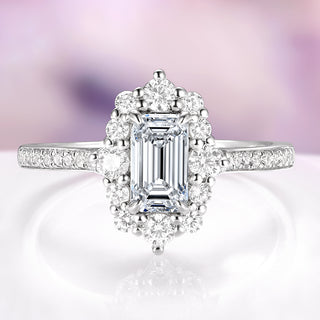


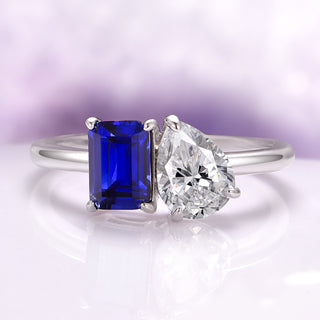

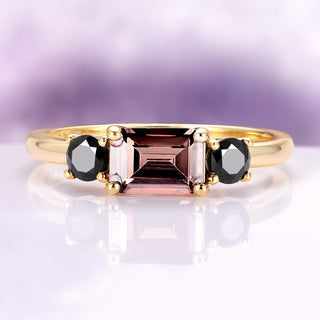


Emerald cut designs sit in this collection right now, every one built in solid 14K gold — white, yellow, and rose — around a GRA-certified moissanite center stone. Settings run from clean four-prong solitaires through halo, hidden halo, three-stone, toi et moi, and vintage-inspired frames, and the same architectural cut in other stones lives in emerald cut rings across every other gemstone.
Why the Emerald Cut Suits Moissanite
The emerald cut and the round brilliant are the two most studied cuts in modern gemology, and they do almost opposite things with light. A round brilliant uses 58 triangular and kite-shaped facets to maximize light return as bright concentrated sparkle. An emerald cut uses long parallel step facets — typically 50 to 58 of them — to produce broad, mirror-like light returns shaped like flat planes rather than bright points.
This matters specifically for moissanite. Moissanite has a refractive index of 2.65 (compared to diamond's 2.42), which means light bends more dramatically inside the stone and produces more visible spectral color separation when it exits — what jewelers call "fire" or "rainbow dispersion." In a round brilliant cut, this extra fire reads as bonus sparkle. In an emerald cut, where the broad step facets act as windows rather than prisms, the extra fire produces something rarer: clean rectangular flashes of color that move across the stone as the wearer moves.
The practical result is that emerald cut moissanite has a distinctly different visual character than emerald cut diamond. Diamond emerald cuts read as quiet, restrained, and architectural. Moissanite emerald cuts read as architectural with a hidden lightning storm — calm at rest, dramatic in motion. For buyers who want the elegant emerald shape but find diamond emerald cuts visually flat, moissanite restores the optical interest.
The emerald cut also reveals stone clarity more honestly than any other cut. Where brilliant cuts hide internal inclusions in their faceting complexity, emerald cuts show every flaw because the broad step facets create direct sight lines into the stone. This is why high-quality emerald cut diamonds carry a price premium over equivalent rounds — clarity has to be genuine, not visually hidden. Lab-grown moissanite avoids this problem entirely. Moissanite is grown with very high clarity standards as a baseline, which makes it particularly well-suited to the unforgiving emerald cut. You see the stone clearly, and what you see is clean.

Emerald Cut Moissanite Engagement Ring Styles
Emerald Cut Moissanite Solitaire
The simplest configuration: a single emerald cut moissanite center stone, no accent stones, clean band. An emerald cut moissanite solitaire is the most architecturally honest version of the cut — nothing competes for attention, the geometry of the stone carries the whole ring visually. Solitaire settings work particularly well for emerald cut moissanite because the cut's long rectangular outline reads as inherently structured; adding decorative elements can risk crowding it.
Most emerald cut moissanite solitaires use a four-prong setting at the corners, which lets the maximum amount of light reach the stone while securing the four most vulnerable points. Six-prong variants exist but are less common because the additional prongs interrupt the clean rectangular outline. For broader solitaire engagement options, see solitaire engagement rings and solitaire moissanite engagement rings.
Emerald Cut Moissanite Hidden Halo
A hidden halo places a ring of small accent stones beneath the center stone's girdle, visible only when the ring is viewed from the side or at an angle. From directly above, the ring reads as a clean solitaire. As the wearer moves their hand, the hidden halo catches light from new angles and reveals additional brilliance the face-on view doesn't suggest.
The hidden halo configuration is especially well-suited to emerald cut moissanite because the cut's flat, broad profile gives the hidden halo more visible angles than rounder cuts allow. With an emerald cut, even small movements of the hand reveal different facets of the hidden halo, producing brilliance that feels intermittent and discovered rather than constant. For broader hidden halo options, see hidden halo engagement rings and hidden halo moissanite rings.
Emerald Cut Moissanite Halo
A traditional halo surrounds the center stone with smaller accent stones, amplifying the visual scale of the ring and adding sparkle around the perimeter. On an emerald cut moissanite specifically, the halo follows the rectangular outline of the center stone, which produces a setting with a distinctly architectural overall silhouette — a larger rectangle made of one bigger stone surrounded by smaller stones, rather than the more circular halo silhouette common with round center stones.
For buyers choosing between halo and hidden halo, the practical difference is visibility: halo for full constant brilliance, hidden halo for selective reveal. Browse the broader halo engagement rings and halo moissanite engagement rings collections.
Emerald Cut Moissanite Three-Stone
Three-stone settings flank the emerald cut center stone with two smaller stones on either side, traditionally interpreted as representing the past, present, and future of a relationship. For emerald cut moissanite specifically, three-stone configurations work in two formats: matching emerald cut side stones (most architectural, fully unified geometry) or contrasting brilliant-cut or trapezoid-cut sides (more visually dynamic, plays the cuts against each other).
For the broader three-stone range across cuts, see three stone moissanite rings.
Emerald Cut Moissanite in Vintage and Art Deco Settings
Emerald cuts have a distinguished history in vintage and art deco jewelry — the cut itself was developed in the 1920s and reached peak popularity during the Art Deco period (1920s-1940s), when geometric purity and architectural symmetry defined fine jewelry design. An emerald cut moissanite in a vintage-inspired setting with milgrain detailing, symmetrical side stones, or geometric metalwork carries this design lineage authentically.
For the broader vintage range, see vintage antique engagement rings and vintage moissanite engagement rings.
Emerald Cut Moissanite in Nature-Inspired Settings
The architectural rectangle of the emerald cut creates striking visual contrast against organic leaf, vine, and botanical setting motifs. Where a round center stone reads as harmonious within nature-inspired settings, an emerald cut reads as the deliberate intrusion of geometry into organic form — which can be exactly the right effect for buyers who want their ring to balance nature and structure rather than committing fully to either. For the broader nature-inspired range, see nature-inspired engagement rings, leaf engagement rings, and fairy engagement rings.
GRA Certification — What It Guarantees
Every emerald cut moissanite stone in this collection is GRA-certified (Gemological Research Association) before it reaches the setting. The certification accompanies your ring on shipment and includes:
- Carat weight — verified to two decimal places
- Dimensions — length, width, depth in millimeters
- Color grade — D, E, or F equivalent (colorless category)
- Clarity grade — VVS equivalent or better (very, very slightly included)
- Cut quality — proportions verified for optimal light return
- Stone origin — lab-grown, with traceability to the production facility
Why this matters: moissanite quality varies significantly between suppliers. Lower-grade moissanite shows yellow or green color tints under specific lighting, visible inclusions, and poor cut proportions that dull the stone's brilliance. Without third-party certification, you're trusting the seller's word that the stone meets the grade specified. With GRA certification, the specifications are independently verified and documented.
For the full optical and material comparison between moissanite and diamond, read our complete moissanite vs. diamond guide and moissanite engagement rings guide.
Choosing Your Emerald Cut Moissanite — Length-to-Width Ratio
Like all elongated cuts, emerald cut stones have a length-to-width ratio that materially affects the stone's visual character. Most buyers prefer ratios between 1.30 and 1.50 for emerald cut moissanite, with 1.40 considered the traditional balanced proportion. The trade-offs:
- Lower ratios (1.20–1.30): more square-feeling emerald cut, closer in feel to the Asscher cut, reads more compact on the finger
- Standard ratios (1.30–1.45): balanced classic emerald proportions, the most common preference, well-suited to traditional solitaire and halo settings
- Higher ratios (1.45–1.60): more dramatically elongated, stronger finger-lengthening effect, particularly striking in three-stone configurations
- Very high ratios (1.60+): distinctly elongated baguette-leaning territory, less common but available for buyers who want maximum elongation
Every GRA-certified emerald cut moissanite in this collection carries its specific length-to-width ratio on the certificate. For buyers uncertain which ratio suits their preference, the balanced 1.35-1.45 range is the safest default for a classically proportioned emerald cut.

Emerald Cut Moissanite vs. Emerald Cut Diamond
This is the comparison most buyers run before committing, and it deserves an honest answer rather than marketing positioning.
What's the same:
both are durable enough for a lifetime of daily wear (diamond Mohs 10, moissanite Mohs 9.25). Both can be cut into the same emerald-cut proportions. Both are produced through controlled processes today (lab-grown diamond and lab-grown moissanite both exist). Both look essentially identical to casual observers under normal lighting conditions.
What's different:
moissanite has a higher refractive index, which produces more visible rainbow fire — particularly noticeable under direct sunlight or spotlights. Some buyers love this extra optical activity; others find it more theatrical than they want from a wedding-grade stone. Diamond is harder, but at this hardness range the difference is academic for daily wear (both stones effectively don't scratch in any normal use). The biggest practical difference is price: a 2-carat emerald cut moissanite ring typically costs a fraction of an equivalent emerald cut lab-grown diamond ring, and an even smaller fraction of a natural diamond equivalent.
Where moissanite has a specific advantage in emerald cuts:
emerald cuts show clarity unforgivingly because the broad step facets create direct sight lines into the stone. Moissanite's high baseline clarity makes it particularly well-suited to this exposure. With emerald cut diamonds, achieving comparable clarity often requires paying significant premiums for higher VS or VVS grades; with emerald cut moissanite, that clarity is the standard.
For the full comparison across every cut and consideration, read our moissanite vs. diamond guide. For lab-grown diamond emerald cut alternatives, see lab-grown diamond engagement rings.
Metal Options for Emerald Cut Moissanite Rings
Sterling Silver Emerald Cut Moissanite
925 sterling silver is the most accessible metal for an emerald cut moissanite engagement ring. Genuine precious metal, fully repairable, at a price point that reads as engagement-ring-serious without requiring solid gold's commitment. The cool silver tone keeps moissanite's brilliance reading as diamond-like, which suits buyers who want the emerald cut's understated elegance without warm metal influence.
Sterling silver emerald cut moissanite works particularly well as an initial engagement ring (with a planned solid gold upgrade at a milestone anniversary), as an alternative engagement piece for couples not drawn to traditional bridal aesthetics, or as a non-bridal commitment ring where the cut's sophistication still reads clearly. For the broader silver engagement range, see sterling silver engagement rings.
Gold Vermeil Emerald Cut Moissanite
Gold vermeil — sterling silver with a thick (2.5+ micron) gold layer that meets US FTC standards — delivers gold aesthetics at a fraction of solid gold's price. Vermeil emerald cut moissanite rings come in yellow gold, white gold, and rose gold options.
The metal-stone interaction matters more than buyers often realize. Yellow gold vermeil amplifies moissanite's natural warmth and creates a vintage-leaning aesthetic. Rose gold vermeil introduces warm pink tones that pair particularly well with peach or champagne-tinted moissanite variants and create a softer, more romantic register than yellow gold. White gold vermeil keeps the moissanite reading as cool and bright, similar to silver but with the slight warmth of gold underneath. See the broader gold vermeil jewelry, yellow gold vermeil jewelry, and rose gold vermeil rings collections.
Solid 14K Gold Emerald Cut Moissanite
The premium tier within the collection: solid 14K gold throughout the entire ring — 58% gold alloy, no silver base. Available in white, yellow, and rose gold. Solid 14K gold emerald cut moissanite rings are the choice for buyers who want permanent gold material value alongside moissanite's optical performance. Heirloom-grade. Infinitely repairable. Holds material value across decades.
For the broader solid gold engagement ring range, see solid gold engagement rings.
Black Ruthenium Emerald Cut Moissanite
For alternative, gothic, or dark-romantic aesthetics, black ruthenium finish over sterling silver creates dramatic contrast that makes moissanite's white-light brilliance read more intensely. An emerald cut moissanite on a black ruthenium band reads as deliberately non-traditional — the architectural geometry of the emerald cut amplified by the unexpected dark metal. For the broader dark-aesthetic range, see lovers of the dark™ black engagement rings and gothic engagement rings.
Care for an Emerald Cut Moissanite Engagement Ring
Moissanite is the second-hardest gemstone used in engagement rings — Mohs 9.25, behind only diamond at 10 and ahead of sapphire at 9. That hardness translates to decades of daily wear without scratching, clouding, or visible surface wear. The stone itself is essentially maintenance-free.
The emerald cut's flat top surface (the "table") collects fingerprints, lotion residue, and cosmetic buildup more visibly than rounder cuts because the broad flat facets show smudges directly. This is purely a visual consideration — the stone isn't damaged by buildup, just less brilliant when it accumulates. Quick cleaning restores the brilliance instantly.
To clean: warm water, mild dish soap, soft brush. Moissanite handles ultrasonic cleaners safely, though softer metal settings (sterling silver, vermeil) may be affected — check individual setting tolerance.
For the metal: sterling silver and vermeil benefit from occasional polishing to maintain brightness. Solid gold holds finish longer and tolerates more cleaning. Black ruthenium should be hand-cleaned only.
Daily wear: remove before heavy manual work, gym sessions involving direct ring contact, swimming in chlorinated pools, and direct exposure to harsh cleaning products. Apply lotions and perfumes before putting the ring on.
For complete care across every metal and stone, see our jewelry care guide. For metal-specific guidance, see the precious metal guide. For vermeil specifics, see the gold vermeil guide.
Matching Wedding Bands for Emerald Cut Moissanite
An emerald cut engagement ring's geometry matters more for wedding band coordination than rounder cuts do. Three patterns work well:
Straight plain band — the simplest pairing, works with any emerald cut setting. The clean line of the band echoes the clean rectangular outline of the stone without competing with it. Most architecturally honest pairing.
Diamond or moissanite eternity band — small accent stones in a continuous band around the wedding ring. For emerald cut center stones specifically, baguette eternity bands (small rectangular stones) or step-cut eternity bands echo the geometry of the emerald cut and create visual continuity between engagement and wedding rings.
Contoured band — shaped to sit flush against the engagement ring's setting. Less common with emerald cuts than with rounded settings, but can work for hidden halo or decorative emerald cut settings where a straight band would leave a visible gap.
For matching wedding bands, see solid gold wedding bands, sterling silver women's wedding bands, and curved wedding bands. For coordinated engagement-and-wedding sets, see couples engagement ring sets, couples wedding ring sets, and the matching couples rings guide.
Popular Engagement Ring Styles: Solitaire, Halo, Three Stone, Hidden Halo, Vintage Antique.
Every piece ships worldwide with insured delivery and a 14-day return window on non-customized pieces. We hold a 4.9-star average across 38,000+ reviews collected on our store and on Etsy, where we have sold since 2016.
From the Blog

Moissanite vs Lab Diamond - Complete Comparison Guide
Moissanite vs lab-grown diamond compared: sparkle and fire, hardness, price, durability, how to tell them apart, and which is the better choice for your ring.

Moissanite vs Cubic Zirconia: Key Differences You Need to Know
Moissanite vs cubic zirconia compared: hardness, sparkle, how long each lasts, whether CZ clouds, price, and which diamond alternative is right for your ring.

Promise Ring vs Engagement Ring: What's the Real Difference?
Promise ring vs engagement ring: the real difference in meaning, timing, which finger each goes on, cost, and style — plus whether one can become the other.

Is Moissanite A Lab-Grown Diamond?
Is moissanite a lab-grown diamond? No — here's the clear answer, why the two are confused, what each stone really is, whether moissanite is fake, and how to choose.
Emerald Cut Moissanite Engagement Rings FAQs
“Absolutely love this ring! It's so beautiful and so shiny.”
“I love my new ring. It's exactly what I wanted.”
“I love my ring! It's so beautiful and delicate.”
“I loved it so much! The stone is beautiful and I can't stop looking at it in the sun.”