





Free U.S. Shipping
Dispatched from the USA with care

Hustle-Free Returns & Exchanges
Simple, worry-free process

Ethically Crafted
Responsibly sourced, consciously made

Loved by 200,000+ Couples
Fantasy-inspired, handcrafted jewelry
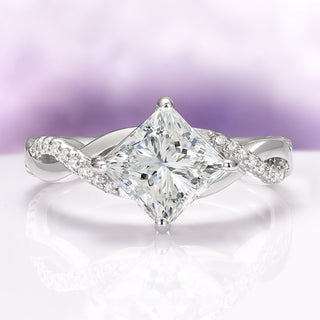
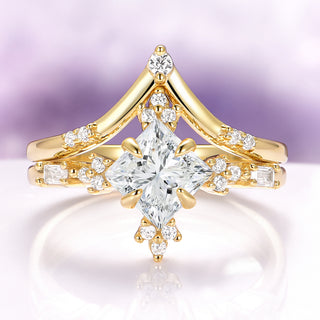
Princess cut moissanite engagement rings take a square outline and apply brilliant-cut faceting to it, which is why they sparkle like a round rather than flashing like an emerald cut. The trade is structural: a princess has four pointed corners, and those corners are the most vulnerable part of the stone. Everything worth knowing about choosing one follows from that single fact.
What a Princess Cut Actually Is
A square modified brilliant. The outline is square or near-square, but the faceting underneath follows brilliant-cut principles rather than the stepped, parallel facets of an emerald or asscher. That combination gives you a clean geometric shape with the light behavior of a round.
It is also the most efficient popular cut in terms of material. A princess retains substantially more of the original rough than a round does, because the square outline wastes less at the edges — which is why a princess tends to read larger per carat than a round of the same weight.
The shape carries a period association as well. The princess emerged in its modern form in the 1960s and 70s and became the defining alternative to the round through the 1980s and 90s, which is why it reads as contemporary-classic rather than as either traditional or unusual. That middle position is much of its appeal.
The Corners, and Why They Decide the Setting
Four sharp corners on a square stone are four points where the material comes to an edge, and edges concentrate force. This is true of any princess cut regardless of what it is made of — hardness resists scratching, but it does not prevent a sharp corner from chipping under a direct knock.
The answer is settings that cover the corners. V-tip prongs wrap each corner in metal; a bezel encloses the whole outline. Either approach removes the vulnerability entirely, and both are standard practice rather than an upgrade. A princess in four simple round prongs that leave the corners exposed is the arrangement to avoid.
This is worth raising before the stone is chosen rather than after, because it constrains which settings are viable. If you have a specific setting in mind that leaves corners open, a shape without corners will serve you better than forcing the princess into it. See moissanite rings for other outlines.
Princess Cut Moissanite and Its Fire
Moissanite disperses light far more strongly than diamond — roughly 0.104 against 0.044 — and its refractive index is higher at about 2.65 versus 2.42. In a brilliant-faceted cut, that produces visible spectral flashes rather than mostly white sparkle.
The princess sits usefully between extremes here. It has brilliant faceting, so it does throw moissanite's color, but its larger, flatter facet planes break light into fewer and broader flashes than a round's many small ones. If a round moissanite reads as too busy, a princess often reads as the same material with the volume turned down. Compare at moissanite engagement rings.
Color also behaves slightly differently in a square outline. The corners of a princess concentrate a little more depth of material than the center does, so any faint tint in a stone tends to gather there first. In moissanite this is rarely a practical concern, but it is why corner-heavy shapes reward looking at the stone face-up rather than only in photographs.
Size, Carat and How a Square Reads
Because a princess wastes less rough and spreads its weight across a square rather than into depth, it generally reads a little larger face-up than a round of the same carat weight. Measure across the flat side rather than corner to corner — corner measurements overstate how large a stone looks on a hand.
| Carat weight | Approx. side-to-side width |
|---|---|
| 0.50 ct | ~4.4 mm |
| 1.00 ct | ~5.5 mm |
| 1.50 ct | ~6.4 mm |
| 2.00 ct | ~7.0 mm |
As with any stone, doubling the carat weight adds only about a quarter to the visible width, since weight scales with volume while width scales linearly.
Wearing a Square Stone Day to Day
A princess pairs cleanly with a straight wedding band, which is a practical advantage over shapes with a curved or pointed outline — no contour band required, no gap to design around. That makes it one of the easier center stones to build a stack around later.
Moissanite at 9.25 on Mohs handles daily wear without difficulty. The ordinary precautions apply: remove any ring for heavy manual work, and with a protected setting the corners are no longer the concern they would otherwise be. See women's wedding bands and engagement rings for women.
Princess Cut Moissanite Engagement Rings FAQs
What is a princess cut?
A square modified brilliant — a square or near-square outline with brilliant-cut faceting underneath rather than the stepped facets of an emerald or asscher. It gives geometric shape with round-like sparkle.
Do princess cut stones chip easily?
The four sharp corners are the vulnerable point on any princess cut, regardless of material — hardness resists scratching but does not stop a sharp corner chipping under a direct knock. V-tip prongs or a bezel remove the risk, and both are standard rather than an upgrade. See engagement rings for women.
Which setting is best for a princess cut?
Anything that covers the corners. V-tips preserve the square outline while protecting each corner; a bezel encloses the whole stone; a halo does both and adds width. Avoid simple round prongs that leave corners exposed.
Does a princess look bigger than a round?
Usually a little, at equal carat weight — a princess wastes less rough and spreads its weight across a square rather than into depth. Measure side to side rather than corner to corner, since corner measurements overstate face-up size.
How much fire does princess cut moissanite show?
Considerable, but less busy than a round. Moissanite disperses light at about 0.104 against diamond's 0.044, and the princess's broader facet planes break that into fewer, larger flashes than a round's many small ones.
Is moissanite the same as a diamond?
No. Moissanite is silicon carbide at 9.25 Mohs with a refractive index near 2.65; diamond is carbon at 10 with 2.42. See moissanite vs lab-grown diamond and is moissanite a lab-grown diamond.
Does a princess cut need a shaped wedding band?
No — its straight edges sit flush against a straight band, which is a practical advantage over curved or pointed outlines. See women's wedding bands.
Can I see other moissanite shapes?
Yes — the full range is at moissanite engagement rings and moissanite rings, with unset stones in loose gemstones.
From the Blog

Moissanite vs Lab Diamond - Complete Comparison Guide
Moissanite and lab-grown diamonds look similar, but differ in sparkle, durability, and cost. Discover which one is the best choice for your ring.

Moissanite vs Cubic Zirconia: Key Differences You Need to Know
Moissanite and cubic zirconia are both diamond alternatives, but they're very different. Find out which sparkles more, lasts longer, and fits your budget best.

Promise Ring vs Engagement Ring: What's the Real Difference?
A promise ring and an engagement ring can look identical - but each tells a completely different love story. This guide covers what sets them apart, the history behind both...

Is Moissanite A Lab-Grown Diamond?
Whether you are envisioning a custom engagement ring, a sculpted wedding band, or a one-of-a-kind creation crafted with intention, we invite you to experience both stones side by side.