


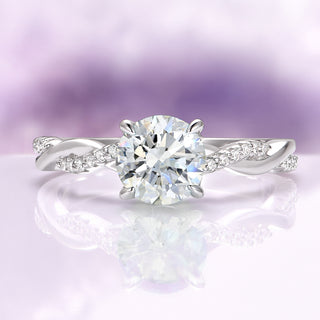


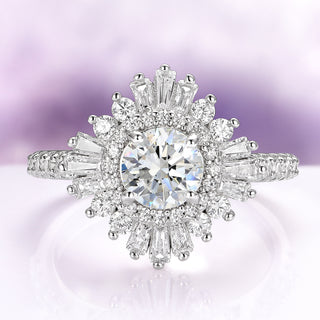


Round moissanite engagement rings pair the most light-efficient cut ever devised with the most dispersive stone commonly set in one. The round brilliant's 57 or 58 facets are arranged to return the maximum possible light to the eye — and because moissanite disperses light roughly two and a half times as strongly as diamond, that arrangement produces noticeably more colored fire than the same cut in any other stone.
Why the Round Brilliant Returns the Most Light
The round brilliant is the only cut designed mathematically rather than by tradition. Its proportions were calculated to bounce light back through the top of the stone instead of leaking it out of the sides, and every other brilliant cut since is a variation on that geometry applied to a different outline.
Symmetry is what makes it work. A round has no corners, no long axis and no orientation — light entering from any direction meets the same facet arrangement. That is also why round is the most forgiving cut for a stone with minor inclusions, since the scatter of returned light conceals more than an open-faceted cut would.
That forgiveness runs the other way too. Because a round hides small imperfections well, paying up for the very highest clarity grade shows less on a round than it would on a step cut, where long open facets leave inclusions nowhere to hide. On a round, cut quality is usually where the same money shows more.

Round Moissanite and the Fire Question
This is the thing worth understanding before choosing. Moissanite has a dispersion of about 0.104 against diamond's 0.044, meaning it splits white light into spectral colors far more strongly. Its refractive index is also higher — roughly 2.65 against 2.42.
Put that stone into the cut engineered for maximum light return and the effect compounds. A round moissanite throws visible rainbow flashes in ordinary daylight, where a round diamond of the same size returns mostly white brilliance. Whether that reads as spectacular or as too much is entirely personal, and it is the single most useful thing to know in advance.
Lighting changes it more than most people expect. Under diffuse indoor light the difference between a round moissanite and a round diamond is modest. Under direct sunlight or spotlighting the moissanite separates sharply, throwing color a diamond simply does not produce. If you can, look at one in both conditions before deciding.
If you want less fire: the cut is your lever, not the stone. Step-influenced and elongated cuts break light into fewer, larger flashes. Round maximizes the effect. See moissanite engagement rings for the full range of shapes.
What Moissanite Actually Is
Silicon carbide, not carbon — which makes it a distinct mineral rather than a diamond substitute in the way cubic zirconia is. It was first identified in a meteorite crater by Henri Moissan in 1893, and the material used in jewelry is laboratory-grown because natural moissanite is vanishingly rare.
At 9.25 on the Mohs scale it sits just below diamond's 10 and above sapphire's 9, which places it comfortably in daily-wear territory. It is not a lab-grown diamond — that is carbon in the diamond lattice, a genuinely different material. See is moissanite a lab-grown diamond and moissanite vs cubic zirconia.
One genuine physical difference worth knowing: moissanite is doubly refractive, where diamond is singly refractive. Looked at closely through the crown at an angle, facet edges can appear slightly doubled. It is rarely visible to the naked eye at ordinary sizes, but it is the property gemologists use to tell the two apart instantly.

Round Cut Size, Carat and Millimeters
Round is the least size-efficient of the popular cuts, because its weight sits in the depth rather than spread across the surface. A round reads smaller face-up than an elongated shape of identical carat weight — the trade you make for the light return.
Carat weight — approx. face-up diameter
- 0.50 ct — ~5.1 mm
- 1.00 ct — ~6.4 mm
- 1.50 ct — ~7.3 mm
- 2.00 ct — ~8.1 mm
Work in millimeters when comparing. Doubling carat weight adds only about a quarter to the visible width, because weight scales with volume while diameter scales linearly — the most common surprise when a stone arrives.
Settings That Suit a Round Stone
Round is the easiest shape to set, which widens your options rather than narrowing them. Having no corners or points, it has no especially vulnerable area, so prong, bezel and halo settings all work without structural compromise.
A bezel suits anyone wanting the stone protected and flush; prongs let more light in from the sides, which matters more with a dispersive stone than with a diamond. Browse engagement rings for women and moissanite rings for both approaches, or loose gemstones if you want to choose the stone first.
Solid gold pieces are made to order in three to six weeks, with a 14-day return window on non-customized pieces. We hold a 4.9-star average across 38,000+ reviews collected on our store and on Etsy, where we have sold since 2016.
From the Blog

Moissanite vs Lab Diamond - Complete Comparison Guide
Moissanite vs lab-grown diamond compared: sparkle and fire, hardness, price, durability, how to tell them apart, and which is the better choice for your ring.

Moissanite vs Cubic Zirconia: Key Differences You Need to Know
Moissanite vs cubic zirconia compared: hardness, sparkle, how long each lasts, whether CZ clouds, price, and which diamond alternative is right for your ring.

Promise Ring vs Engagement Ring: What's the Real Difference?
Promise ring vs engagement ring: the real difference in meaning, timing, which finger each goes on, cost, and style — plus whether one can become the other.

Is Moissanite A Lab-Grown Diamond?
Is moissanite a lab-grown diamond? No — here's the clear answer, why the two are confused, what each stone really is, whether moissanite is fake, and how to choose.
Round Moissanite Engagement Rings FAQs
“This ring is absolutely beautiful and very well made. I love it so much.”
“This ring is so much more beautiful in person.”
“This ring was just perfect for my wife.”
“Looks just like it does in the picture. Beautiful piece.”