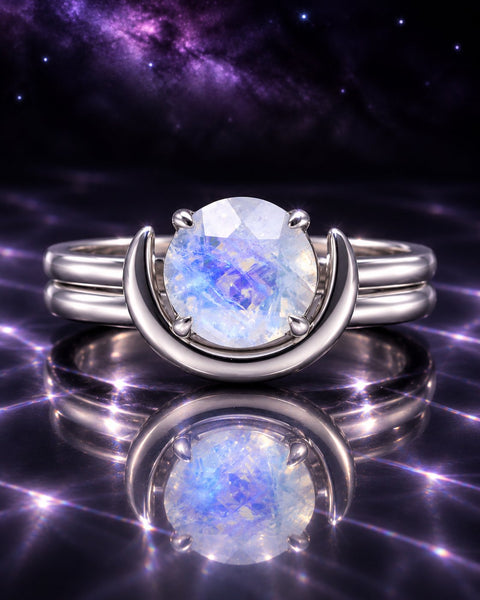
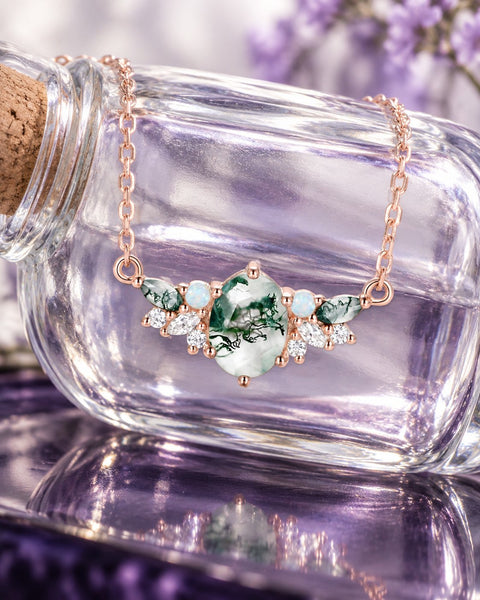
Nerida in white and violet. A 5.5 × 10 mm oval lab-grown white sapphire sits in four prongs inside a kite-shaped frame of engraved leaves, with a round natural amethyst at each of the four points and a split shank that opens into the frame. Solid 925 sterling silver with a rhodium finish.
Lab-Grown White Sapphire
Oval Cut, 5.5 × 10 mm
Natural Amethyst Accents
Engraved Leaf Frame
925 Silver, Rhodium Finish
Sizes 4–11
The Design
Nerida is named for the sea nymphs of Greek myth, and this is the pale version: the oval sits north to south in four prongs inside a pointed, kite-shaped frame with leaves engraved into the metal on every side, so the white stone reads as the center of a larger silver leaf. A single round amethyst marks each of the four points of the kite and the frame's edge is beaded with milgrain. The shank splits as it reaches the frame and runs into its two side points, which keeps the frame open and light rather than solid. The same Nerida mount is made in black ruthenium with lab-grown Paraiba spinel, lavender opal and ruby.
Our oval engagement rings guide covers why the cut flatters the hand, white sapphire vs diamond covers how the center compares to a diamond, and vintage engagement rings covers the filigree lane this ring belongs to. For the wider field, non-traditional engagement rings.
The Stones
The center is lab-grown white sapphire, grown as corundum with the same chemistry and 9 Mohs hardness as a mined sapphire, colorless and cut as a 5.5 × 10 mm oval. White sapphire has less fire than diamond or moissanite and a cooler, glassier brilliance, which suits the antique frame. Our sapphire guide covers the stone and the September birthstone guide covers sapphire as a gift.
The four accent stones are natural amethyst, the purple variety of quartz, 7 on the Mohs scale, in a true medium violet. Amethyst is the February birthstone; amethyst meaning and the February birthstone guide have more, and amethyst engagement rings covers the stone in bridal settings.
Metal
Solid 925 sterling silver with a rhodium finish, the bright white platinum-group coating used on white gold. It keeps the silver from tarnishing and gives the filigree a crisp white edge against the purple points.
Part of our white sapphire rings, amethyst engagement rings, oval engagement rings, antique and vintage engagement rings and February birthstone collections, alongside the rest of our sterling silver engagement rings and purple gemstone jewelry.
Specifications
-
Center stone: Lab-grown white sapphire, oval cut, 5.5 × 10 mm
-
Accent stones: Four natural amethyst rounds, one at each point of the kite
-
Metal: Solid 925 sterling silver, rhodium finish
-
Setting: Four prongs in an engraved leaf kite frame; split shank
-
Hardness: Sapphire 9, amethyst 7 on the Mohs scale
-
Birthstones: September (sapphire), February (amethyst)
-
Sizes: 4 to 11, including half sizes
-
Engraving: Available, up to 16 characters
-
Presentation: Free luxury velvet jewelry box
Care
Sapphire is 9 on the Mohs scale and amethyst is 7, so both suit daily wear and the rhodium finish is the limiting factor. Clean with warm water, mild soap and a soft brush, working the brush through the filigree where lotion collects, then dry before storing. No silver polishing cloths or abrasive compounds, which wear the rhodium thin; avoid chlorine, ultrasonic cleaners and household chemicals for the same reason. Keep amethyst out of prolonged direct sun, which can fade the color over years. Our how to clean sterling silver and engagement ring care guides cover the rest.
Frequently Asked Questions
Is the white sapphire real?
It is lab-grown sapphire: real corundum, chemically and physically the same as a mined white sapphire, grown in a lab rather than dug up. It is not cubic zirconia or glass.
Does white sapphire sparkle like a diamond?
Not quite. White sapphire has less fire than diamond or moissanite and a cooler, glassier brilliance. It reads as a clear white stone rather than a rainbow one.
Are the purple stones real?
Yes. The four accent stones are natural amethyst, one at each point of the kite frame.
How big is the center stone?
5.5 × 10 mm, oval cut, held in four prongs with the length running along the finger.
Is this a birthstone ring?
Two of them. Sapphire is the September birthstone and amethyst is the February birthstone.
Is it hard enough for everyday wear?
Yes. Sapphire is 9 on the Mohs scale and amethyst is 7. The rhodium finish on the silver, not the stones, is the part to protect.
Does the silver tarnish?
Not the way bare silver does. The ring is solid 925 sterling silver with a rhodium finish, which acts as a barrier against tarnish. After years of daily wear the finish can thin, and the ring can be refinished.
What is the ring made of?
Solid 925 sterling silver with a rhodium finish. No brass or base metal.
Can I stack it with a band?
The kite frame sits above the finger with a split shank, so a slim band stacks against the shank on either side; a wide band will sit below the lower point of the frame.
Does it come in other stones?
Yes. The Nerida mount is also made in black ruthenium with lab-grown Paraiba spinel, lavender opal and ruby, each with matching accent stones.
What sizes are available?
Sizes 4 through 11, including every half size.
Can I have it engraved?
Yes. Engraving is available on the inner band, up to 16 characters, and can be added as an option at checkout.
Are the stones ethically sourced?
Yes. All Aquamarise stones are conflict-free and responsibly sourced, and every order arrives in a free luxury velvet jewelry box.