


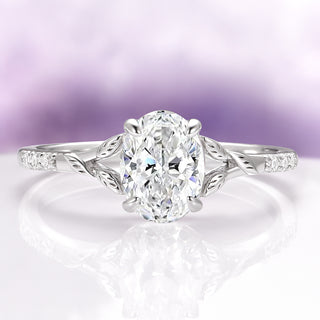

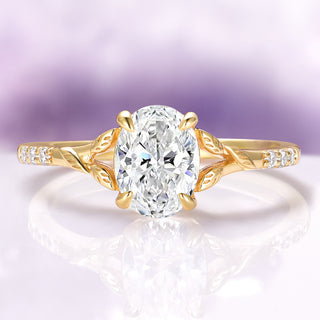
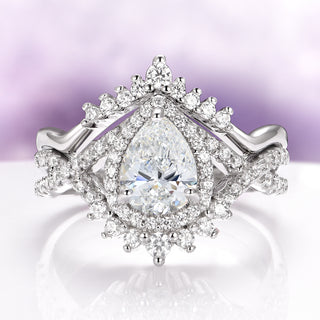


Traditional engagement rings are the classics — a clear center stone in a timeless setting, without unusual cuts or statement details. They stay in style precisely because they don't chase it: a solitaire, a halo, or a trilogy on a clean metal band has looked right for a century and will look right in fifty years. This collection gathers our traditional designs at their most permanent — IGI-certified lab-grown diamond centers in made-to-order solid 14K gold.
Classic Engagement Ring Settings
Three settings define the traditional category. The solitaire puts a single stone on a plain band — the most recognizable engagement ring in the world. The halo encircles the center stone with smaller accents for extra brilliance and apparent size. And the three stone or trilogy setting flanks the center with two side stones, one for each chapter of the story. A pavé band adds sparkle along the shank without changing the classic silhouette.

Traditional Center Stones
The classic choice is a colorless center stone, and here that means IGI-certified lab-grown diamonds — real diamonds, chemically and optically identical to mined stones, with full certification of cut, color, clarity, and carat weight. Round and oval cuts are the most traditional shapes, the ones that defined the category, with princess and emerald cuts close behind for buyers who want classic with a touch of geometry.
Because every stone is certified and every ring is made to order, you choose the carat weight and quality tier that fits your budget rather than settling for what happens to be in a case — the listing states exactly what arrives, grade by grade. It is the difference between buying a ring and commissioning one, at a price that undercuts the mined-diamond equivalent by a wide margin — the certificate in the box says exactly what the stone is, and the stamp inside the band says exactly what the metal is.
Made to Order in Solid Gold
Every ring in this collection is made to order in solid 14K gold — 58.5% pure, stamped 585 — in white, yellow, and rose, with white gold carrying a bright rhodium finish in the classic tradition. Made-to-order production typically takes three to six weeks, because each ring is cast, set, and finished individually rather than pulled from stock. The metals are recycled, the diamonds are lab-grown and fully traceable, and the result is a ring built the way heirlooms used to be: one at a time, for one person. The platinum vs gold guide and 14K vs 18K gold guide cover the metal choice in depth.

Details That Never Date
Tradition rewards small, quiet upgrades. A hidden halo tucks a ring of accent stones beneath the center — invisible from above, glittering from the side — so the classic top view stays untouched. A cathedral profile raises the stone the way the great mid-century rings did. Pavé along the shank adds light without changing the silhouette a jeweler would have recognized in 1950.
These are the touches that separate a considered traditional ring from a generic one: the silhouette stays canonical while the craftsmanship earns a second look. Pair the finished ring with a straight band from women's wedding bands, or a curved band where a taller setting wants a contoured partner. Every upgrade here is reversible taste, not trend — the ring underneath stays canonical, which is precisely what makes a traditional ring safe to choose for someone whose taste you know less perfectly than your love.
Traditional, Vintage, or Modern?
Traditional means classic, current proportions with no period styling. If you like the familiar silhouette but want era character — milgrain beading, filigree, Art Deco geometry — that is our antique and vintage engagement rings collection. If you'd rather strip the ring to clean geometric essentials, browse modern engagement rings; and if convention itself is the thing you want to leave behind, start with non-traditional engagement rings.
A Classic, Built to Be Kept
Every ring ships worldwide with insured delivery and complimentary engraving, and non-customized pieces carry a 14-day return window. We hold a 4.9-star average across 38,000+ reviews collected on our store and on Etsy, where we have sold since 2016. Certified diamonds and solid gold, made to order.
From the Blog

Engagement Ring Styles & Setting Types: The Complete Guide
The complete expert guide to engagement ring styles and setting types: solitaire, halo, three-stone and more, plus prong, bezel, pavé and channel settings, and how to choose.

How Much Should You Spend on an Engagement Ring?
The real 2026 average, why the two-months-salary rule is a De Beers myth, what percentage of income to spend, cost by carat, lab-grown savings, and how to set a budget...

Lab-Grown Diamonds: The Complete Guide
A complete guide to lab-grown diamonds: are they real diamonds, how they're made, how much they cost, certification, the pros and cons, and whether they're worth buying.

Moissanite vs Lab Diamond - Complete Comparison Guide
Moissanite vs lab-grown diamond compared: sparkle and fire, hardness, price, durability, how to tell them apart, and which is the better choice for your ring.
Traditional Engagement Rings FAQs
“Ring was beautiful! The pictures don't do it justice. My wife loves it!”
“I love it so much! It's so pretty, I could almost cry every single time I look at it.”
“I love this piece and it looks beautiful on.”
“It is perfect! I am absolutely in love with this piece!”