


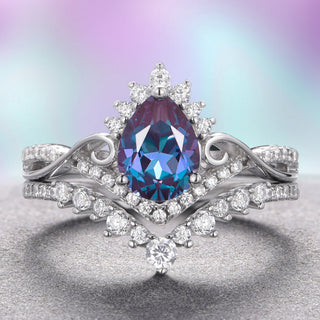


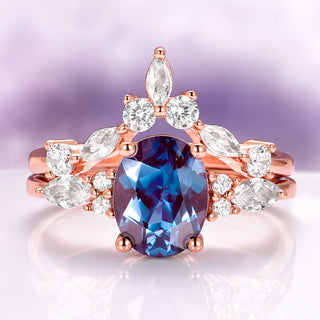

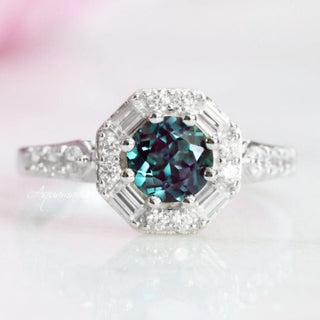

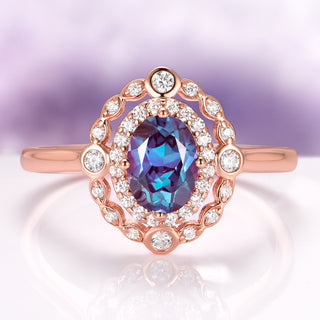
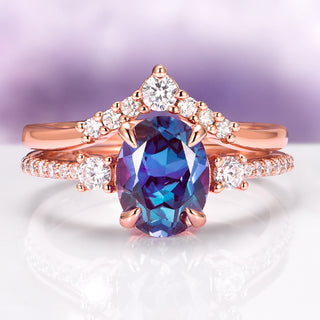


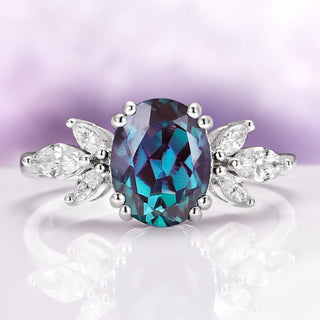


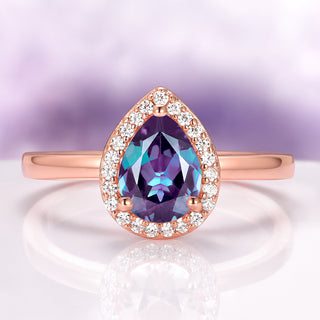

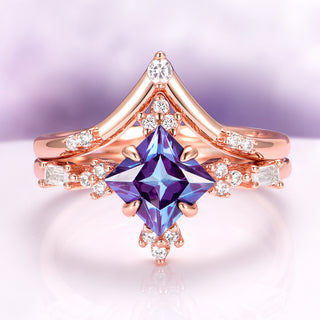
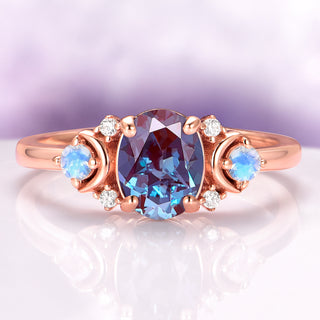
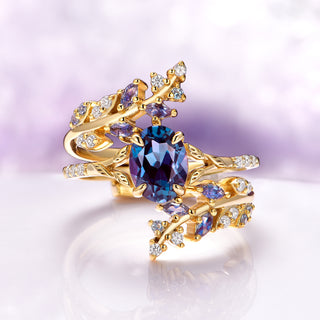



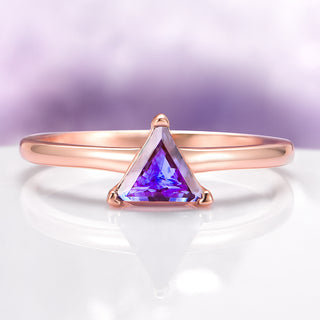

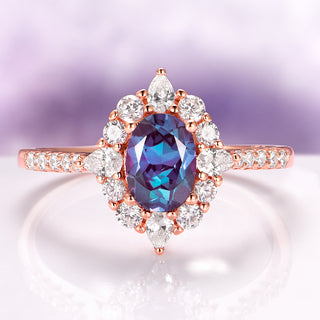


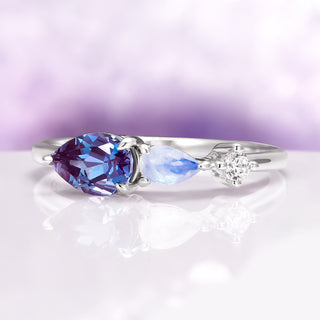


An alexandrite ring refuses to pick one color. Teal-green under daylight, red-purple under restaurant lamplight — the shift comes from trace chromium inside chrysoberyl, and no other bridal stone does it. At Mohs 8.5, alexandrite is harder than emerald or morganite and built for a ring that never comes off.
Alexandrite Engagement Rings for Two Kinds of Light
Browse solitaire, halo, hidden halo, three-stone, toi et moi, vintage and fairy settings in oval, kite, hexagon, pear, cushion and princess cuts — natural and lab-grown stones disclosed on every listing, in 925 sterling silver, 14K gold vermeil, and solid 14K gold. Each setting is chosen to make the color change legible on the hand, because with this stone the setting is not decoration; it is staging.
Engagement Settings That Put the Change on Display
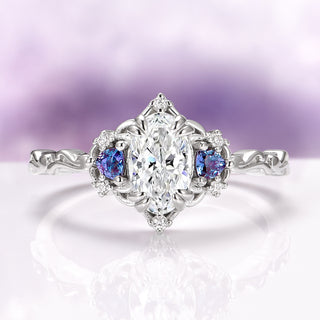
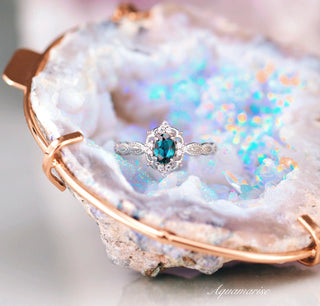
A solitaire isolates the stone so the color change is the only event in the ring — the purist’s configuration, and the one that reads most clearly across a table. A halo rings the center with lab-grown diamonds or moissanite whose white brilliance never changes, so both phases of the alexandrite look more dramatic against a constant frame. A hidden halo tucks that sparkle beneath the girdle: clean from above, lit from the side. Three-stone settings flank the changing center with two steady companions, and vintage and Art Deco designs — milgrain, scrollwork, geometric shoulders — suit a gem discovered in 1830s Russia and prized by its imperial court.
If what draws you is a ring outside convention altogether, alexandrite sits naturally beside the rest of our alternative engagement rings — but no other stone in that company changes its mind at dusk.
From Marquise to Kite: Cuts, Sets & the Custom Route
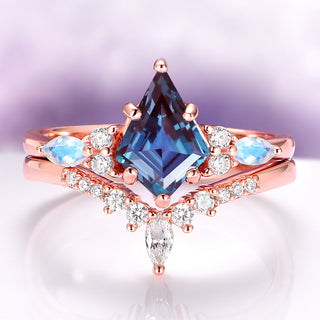
Oval and cushion cuts show the largest continuous field of color, which is why they lead the collection. A marquise alexandrite engagement ring concentrates the shift at its points, so the change appears to travel across the stone as the hand moves; emerald and princess cuts trade sparkle for the truest body color. The kite cut — our signature angular outline — has a dedicated home in kite cut alexandrite engagement rings.
An alexandrite engagement ring set pairs the center stone with a band that echoes the shift instead of competing with it — see alexandrite wedding bands — and partners who want the phenomenon on both hands start with alexandrite couples rings. An alexandrite solitaire ring remains the purist’s choice; an alexandrite diamond ring adds constant white brilliance beside the changing center; and for a fully bespoke custom alexandrite ring — stone, cut, setting, and metal specified from scratch — use Design Your Own Custom Ring. Buyers who love the teal phase often weigh an aquamarine and alexandrite ring pairing, holding the cool color steady beside the stone that will not stay put.

Natural or Lab-Grown: Choosing the Center Stone
Natural alexandrite is mined chrysoberyl and, at fine grades, among the rarest gems on earth — the reason a natural center in solid gold is an heirloom decision rather than a shopping decision. A lab grown alexandrite engagement ring carries genuine chrysoberyl grown under controlled conditions: the same crystal, the same chromium, a true color change, and a price that lets the stone lead. Simulated alexandrite — typically color-change corundum or spinel — shifts differently, blue-gray to purple, and every listing here discloses exactly which stone type it carries, because honesty about the stone is the beginning of trusting the ring.
The most requested women’s alexandrite engagement ring pairs an oval lab-grown center with rose gold vermeil, whose warmth flatters the red phase. For the long-form comparison, read lab-grown vs natural alexandrite; for whether simulants repeat the phenomenon, does synthetic alexandrite change colors settles it.
Silver, Vermeil & Solid Gold Alexandrite Bridal Metals
The most searched budget path is the alexandrite engagement ring in silver: 925 sterling — a 92.5% solid alloy with a bright rhodium finish — carrying a lab-grown stone, part of our wider sterling silver engagement rings tier. 14K gold vermeil, at least 2.5 microns of 10K-or-better gold over sterling by FTC definition, warms the stone’s red phase, and solid gold rings stamped 585 are where natural alexandrite centers become heirlooms. Buyers comparing color stones at the same altar usually shortlist sapphire engagement rings — harder by half a Mohs point, steadier in color — before deciding whether steadiness is actually what they want.
Alexandrite Jewelry Beyond the Proposal
Pendants, studs, drop earrings, wedding bands, and couples sets — everything in the stone that is not an engagement setting — lives in alexandrite jewelry, the hub for the stone itself: its Ural Mountains discovery, its chemistry, and its everyday forms.
Every ring is handcrafted and hand-finished, with worldwide insured shipping, a 14-day return window on non-customized work, and complimentary engraving on eligible designs. We hold a 4.9-star average across 38,000+ reviews collected on our store and on Etsy, where we have sold since 2016. The collection spans sterling silver through solid 14K gold.
From the Blog

Does Synthetic Alexandrite Change Color?
Yes — synthetic (lab-created) alexandrite changes color just like natural alexandrite. How the color change works, how lab alexandrite is made, how to tell it apart, and what it's worth.

Lab-Grown vs Natural Alexandrite: What Shoppers Actually Need to Know
Alexandrite changes color because chromium atoms in its crystal absorb two wavelength ranges simultaneously — leaving both green and red transmission open. The light source determines which color you see....

Alexandrite vs Sapphire: Which Gemstone Feels More Unique?
Alexandrite shifts from green to red. Sapphire holds one color. The physics, durability, price, and styling differences for buyers choosing between these two engagement ring gemstones — with an honest...

Promise Ring vs Engagement Ring: What's the Real Difference?
Promise ring vs engagement ring: the real difference in meaning, timing, which finger each goes on, cost, and style — plus whether one can become the other.
Alexandrite Engagement Rings FAQs
“This ring completely exceeds my expectations and it is absolutely gorgeous! I chose alexandrite for the meaning behind the stone: balance, transformation, joy, and good fortune.”
“This ring is beautiful! I am so happy with it, and I am thrilled they were able to custom size it for my tiny finger!”
“This ring is stunning! It's a perfect fit and so comfortable. The pictures don't do it justice.”
“Beautiful rings. My husband and I are very pleased with them.”